
We earn a commission if you buy through these links. Learn more
The impending crisis
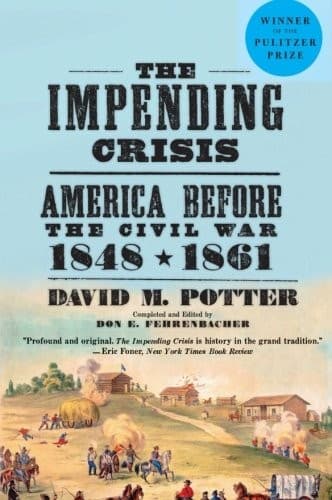
A Pulitzer-winning map of the decade when American leaders kept failing to contain sectional conflict, showing how a crisis that felt inevitable was shaped by specific choices.
What It's About
The Impending Crisis covers the decade from 1848 to 1861, the years between the Mexican War and the secession of the Southern states. Potter's question is not simply why the Civil War happened but how a country that had held together through earlier fights came to believe that a break was coming and to act as if it could not be stopped. He keeps his attention on politics: Congress, the national parties, the compromises of 1850, the fights over Kansas, and the Supreme Court's role in the Dred Scott case.
The book is a work of synthesis rather than a single-thesis polemic. Potter moves between national debates and the local feelings that shaped them, and he is careful about how people at the time understood their own choices. The prose is measured and organized around events, so the narrative builds steadily toward 1860 and 1861. Readers should expect long stretches of legislative detail and a historian's habit of weighing competing explanations.
Reading it is less like being told a story than like being walked through a set of decisions, each of which seemed reasonable at the time. That is its main pleasure. It makes the coming war feel contingent and human, and it rewards readers who want to understand the mechanics of the political system that failed.
Read this if you…
- want a serious, well-organized account of how the Union's political system broke down before 1861
- are interested in the mechanics of Congress, party politics, and the courts during the 1850s
- already know the basic story of the Civil War and want to understand why the decade unfolded as it did
Skip it if you…
- want a short introduction to the Civil War or to slavery as a moral and social system
- are looking for a narrative centered on enslaved people, abolitionists, or Black political life, which receive less space here than the national political story
Key Ideas
- 1
Sectional conflict as a political failure
Potter argues that the crisis was not produced by slavery alone but by the inability of the political system to manage it. Parties broke apart, compromises stopped holding, and leaders who had once bridged North and South found that they could no longer do so without losing their own followings.
- 2
The fading of shared national feeling
A recurring theme is the weakening of the sense that Americans belonged to one country whose institutions deserved loyalty. As regional identities hardened, each side increasingly read the other's actions as threats, which made compromise look like surrender.
- 3
Crisis as something people chose to see
The phrase impending crisis captures a mood as much as a fact. Potter shows how politicians and editors talked themselves into believing a break was inevitable, and how that belief then helped make it so. The argument asks readers to notice where a sense of inevitability was itself a decision.
- 4
Events read through the people who made them
Rather than treating the period as impersonal forces, Potter examines the motives, miscalculations, and rhetorical habits of individual leaders. Readers get a sense of how much depended on particular men making particular bets under pressure.
Limitations
The book's focus is mainly on national politics, especially Congress, the parties, and leading figures, so readers looking for the experiences of enslaved people or grassroots activism will find them underrepresented. Potter did not live to finish the manuscript, and it was completed by Don E. Fehrenbacher, a fact readers should keep in mind when judging its polish and structure. Its historiography also reflects the mid-century field, and later scholars have pushed harder on slavery as the central cause and on the agency of those the political story leaves at the margins.
Questions Readers Ask
- Is The Impending Crisis still worth reading?
- Yes, for readers who want a thorough political account of the 1850s. Later historians have given slavery and Black political action more central roles, so it helps to read it alongside newer work. Its strength is the careful tracing of how the national system failed, which remains useful for understanding the period.
- How does it compare with Eric Foner's Fiery Trial?
- Foner's book is organized around Lincoln and the place of slavery in his thinking, and it is more focused on a single figure and on the moral dimensions of the issue. Potter's book is broader and more concerned with the political system as a whole. Readers who want the big political picture should start here, while those interested in Lincoln's views may prefer Foner.
- Published
- 1976
- ISBN
- 9780061319297
- Difficulty
- intermediate
- Category
- History
Book details and cover from Google Books.
Ready to read The impending crisis?
Get your copy on Amazon, or listen to it on Audible. We earn a commission if you buy through these links.