
We earn a commission if you buy through these links. Learn more
The Immortal Life of Henrietta Lacks
Guide by the Books of the Day editors · Updated · How we write our guides
A rare book that treats a single cell line as a human story, weaving the science of HeLa cells together with the family who never knew how much their mother's body had given to medicine.
What Creators Say About The Immortal Life of Henrietta Lacks
2 creators reviewed The Immortal Life of Henrietta Lacks on YouTube between 2010 and 2018, with 105.1K views between them. Their opinions are their own; we picked these reviews, we didn't write them.
What It's About
The Immortal Life of Henrietta Lacks follows two stories that eventually meet. The first is the life of Henrietta Lacks, a Black mother of five from Turner Station, outside Baltimore, who died of cervical cancer in 1951 at Johns Hopkins Hospital. Doctors took samples of her tumor without asking her, and her cells turned out to grow in the lab in a way no others had. The resulting HeLa line became one of the most widely used tools in biomedical research, supporting work on polio, cancer, and genetics, while her family was largely kept in the dark for decades.
The second story belongs to Rebecca Skloot, who spent years tracking down the Lacks family, especially Henrietta's daughter Deborah, and earning their trust. The book moves between family history, scientific explanation, and Skloot's own reporting, so she is often visible on the page. Her reporting is careful and her science explanations are clear for non-specialists, though she takes time to show the emotional stakes rather than just the research milestones.
Reading it feels less like a textbook and more like a long investigation with a personal center. It is emotionally heavy, and some passages slow down for family detail. Readers who want a brisk history of cell biology may find the balance uneven, but most come away with a sharper sense of who medicine has relied on and who has been left out of the credit.
Read this if you…
- want a nonfiction book that combines science history with a deeply personal family story
- are interested in medical ethics, consent, or how research credit gets assigned
- like narrative journalism that shows the reporter's process and her doubts
Skip it if you…
- want a concise, purely scientific account of cell biology or cancer research
- need a fast-paced read, since the family sections often slow the pace
Key Ideas
- 1
Cells taken without consent
Henrietta's tissue was collected during treatment with no informed consent, which was common practice at the time. The book uses this to examine how medical norms of the 1950s treated patients, especially poor Black patients, as sources rather than people with rights over their own bodies.
- 2
Science built on an unnamed person
The HeLa line supported work that won major prizes and shaped treatments, yet the donor's name stayed out of the scientific record for decades. Skloot shows how research credit, anonymity, and commercial interest can separate a discovery from the person who made it possible.
- 3
Race, class, and trust in medicine
The Lacks family's poverty, the segregated health system of the era, and their later suspicion of doctors all shape the story. The book asks why the family was so distrustful and what it means for a medical system to earn that trust back.
- 4
Writing as a relationship with subjects
Skloot's years of visits, phone calls, and misunderstandings with Deborah Lacks are part of the subject. The book reflects on who gets to tell someone else's story and what a journalist owes the people whose lives she describes.
Limitations
Some critics have said the book leans heavily on Skloot's own role and emotional arc, which can crowd out the Lacks family's voices at times. Others found the scientific explanations simplified, and some readers wanted more on how HeLa research has developed since the book appeared. The narrative also reflects a particular period of reporting and a single author's perspective, so it is best read as one account among several rather than a complete history of the cells or the family.
Questions Readers Ask
- Is the book hard to read if I don't have a science background?
- No. Skloot explains cell culture, viruses, and the research context in plain language, and she frames each scientific point around a human question. Readers without a science background usually find the book accessible, though a few passages on lab techniques may need a second read.
- Is it still relevant, given how much research has changed?
- Yes. The core questions about consent, donor rights, and who receives credit for research remain active debates in genomics and biobanking. The specific science is dated in places, but the ethical issues the book raises are still very much part of medicine today.
- How does it compare to other popular narrative science books?
- It is more personal and more focused on a single family than most popular science books, which usually center on discoveries or scientists. If you like the story-driven style but want a more explanatory, idea-first book, you might prefer a different title.
- Published
- 2009
- ISBN
- 9780330426237
- Difficulty
- beginner
- Category
- Biographies
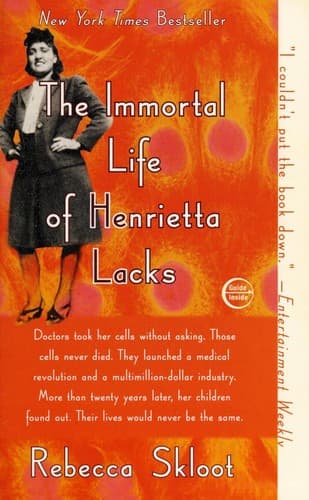
Book details and cover from Google Books.
Ready to read The Immortal Life of Henrietta Lacks?
Get your copy on Amazon, or listen to it on Audible. We earn a commission if you buy through these links.