
We earn a commission if you buy through these links. Learn more
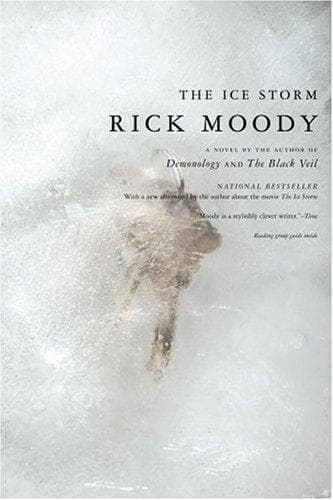
The ice storm
by Rick Moody
Rick Moody's 1973 novel follows two Connecticut families whose marriages are unraveling over one holiday weekend, with a sharp, funny, and cold eye for suburban pretense.
What It's About
The Ice Storm is set over a single holiday weekend in November 1973 in an affluent New Canaan, Connecticut, and follows two neighboring families, the Hoods and the Williamses. Ben Hood is restless and drifting toward an affair, his wife Elena is searching for something she cannot name, and their teenagers are sampling the freedoms of the decade in ways their parents barely notice. Moody moves among many characters' heads, so the novel feels crowded with small, sad decisions.
Moody's style is the main event. His sentences are long, observant, and dense with period detail: brand names, television, and the anxieties of Watergate and the sexual revolution seeping into living rooms. The tone shifts between dry comedy and something closer to dread, and the narrator is willing to step back and comment on the emptiness of his characters' pursuits. It reads less like a plot-driven story than a slow buildup of unease that gathers toward the weather of the title.
Reading it is an immersive and somewhat uncomfortable experience. You spend time with people who are often unlikable and rarely honest with themselves, and you may laugh at one line and wince at the next. The book rewards patience and close attention, and its setting feels precise rather than nostalgic. Expect a read that lingers long after the last page.
Read this if you…
- enjoy dense, observant literary fiction with a satirical edge
- are curious about America in the early 1970s beneath its surface
- like ensemble novels where many inner lives share the same page
Skip it if you…
- want a brisk plot that moves quickly toward a clear resolution
- need likable protagonists to stay engaged with a story
Key Ideas
- 1
Suburban respectability as a thin surface
The houses, dinner parties, and polite rituals of the Connecticut suburb are presented as a managed performance. Moody keeps returning to the gap between how these families look from the street and what is happening inside them, and that gap is where most of the book's tension lives.
- 2
Sexual freedom that fails to deliver happiness
The novel takes seriously the promise of 1970s liberation and then shows how its experiments leave many characters lonelier and more confused. It is not a moral lecture so much as a clear-eyed look at appetites that outrun any real capacity for intimacy.
- 3
Teenagers watching adults fail
The younger characters see their parents' hypocrisy with painful clarity and begin to copy the very behavior they condemn. Their perspective gives the book some of its sharpest observations and a sense that the damage is being passed along.
- 4
Weather as mood and warning
The ice storm of the title works as a controlling image, a hard, brittle force that makes the familiar world dangerous and fragile. Moody uses the environment to mirror the instability of the people inside it without spelling out the connection.
Limitations
The book's cast is large and its perspectives shift often, so some readers find the characters blur together or never fully come into focus. Its bleakness is relentless, and the emotional registers can feel repetitive to those who prefer warmth or clear arcs. The satire of suburban life, while sharp, owes a debt to earlier writers of the American suburb, and some readers will find the critique familiar. The period details are deliberate, but they can feel dated for readers without a memory of the era.
Questions Readers Ask
- Is The Ice Storm still worth reading today?
- Yes, especially if you care about how families hide their troubles behind routine. The themes of dishonesty, restlessness, and the gap between public image and private life remain current. The 1970s setting feels specific and dated in places, but Moody uses that detail to sharpen the book's observations rather than to indulge nostalgia.
- How does it compare to Richard Yates or John Cheever?
- Readers who enjoy Richard Yates's Revolutionary Road will recognize the mood of disappointed marriages and suburban self-deception. Moody is looser, funnier, and more digressive than Yates, and his prose is more restless. If you like Cheever's sharp suburban stories, you will find a similar eye for social surfaces here, but with a harder edge.
- Is the 1997 film a good substitute for reading the novel?
- The Ang Lee film is well regarded and captures the period atmosphere, but it cannot reproduce Moody's prose or the way the novel moves between minds. The book is more diffuse and interior, so reading it gives you the texture and layered perspective that a two-hour adaptation has to compress.
- Published
- 1994
- ISBN
- 9780349106410
- Difficulty
- intermediate
- Category
- Fiction
Book details and cover from Google Books.
Ready to read The ice storm?
Get your copy on Amazon, or listen to it on Audible. We earn a commission if you buy through these links.