
We earn a commission if you buy through these links. Learn more
The Hitchhiker's Guide to the Galaxy
Adams's giddy, deadpan space comedy turns an ordinary man's bad morning into a galaxy-wide adventure, and remains one of the funniest short novels in English.
What It's About
The book opens with Arthur Dent, a fairly unremarkable Englishman, whose house is due for demolition to make way for a bypass. The same day, his friend Ford Prefect reveals that he is an alien researcher for a travel guide meant to cover everything in the galaxy, and that Earth is about to be destroyed to clear a hyperspace route. What follows is a loose, episodic journey across space with a mismatched group of companions, including the two-headed, impulsive Zaphod Beeblebrox and Marvin, a chronically depressed robot. The plot wanders on purpose, and it is more a string of strange situations than a tightly built mystery.
The style is the real draw. Adams writes in short chapters with a deadpan, slightly weary narrator who treats cosmic catastrophe as an inconvenience. Jokes arrive quickly and often hinge on the gap between enormous scale and small human concerns like tea, buses, and dressing gowns. Interspersed passages from the Guide itself are satirical mini-essays that poke at bureaucracy, tourism, and the self-importance of reference books. Reading it feels like sitting with a very quick, very dry friend who keeps undercutting every grand statement.
The experience is fast and light. It is a short book by modern standards, and you can finish it in a few sittings. It is less about emotional depth or world-building than about momentum, wit, and a sense of wonder shaped by British comic sensibility.
Read this if you…
- want science fiction that treats the universe as a cosmic joke
- enjoy British deadpan humour and fast, quotable jokes
- are looking for a quick, funny read with a real sense of wonder
Skip it if you…
- need tight plotting, consistent rules, or serious world-building
- find a narrator who undercuts every emotional moment exhausting
Key Ideas
- 1
An ordinary man against an indifferent cosmos
Arthur's bewilderment anchors the whole book. He is not heroic or especially clever, and his bafflement at every new development is what makes the strange universe feel strange. Much of the comedy comes from watching a reasonable, mildly grumpy person try to make sense of things that obviously do not care about him.
- 2
Satire of bureaucracy and official process
Adams returns again and again to paperwork, notices nobody read, and officials who follow procedure even when it is absurd. The threat to Earth is delivered through this kind of pointless formality, which gives the book a sharp edge beneath its silliness. The satire lands because the institutions it mocks feel recognisably human.
- 3
The Guide as a comic device
The fictional guidebook lets Adams step outside the story and comment on it. Its entries are short, glib, and often wrong or misleading, which undercuts any attempt at authority. This structure gives the book a second voice that is funnier and more pointed than the main narrative alone.
- 4
Rejecting grand answers for absurd ones
The book mocks the search for meaning by treating it as a joke whose punchline is more ridiculous than anyone expected. Characters pursue huge questions with great seriousness, only to find that the answers are unhelpful or mundane. Readers who enjoy philosophy played for laughs will find this part especially rewarding.
- 5
Friendship and improvisation as the human response
Faced with chaos, the characters rarely have a plan. They muddle through with improvised decisions, loyalty to each other, and a stubborn refusal to panic. The book suggests that decency and curiosity count for more than competence, and that is part of why its absurdity still feels warm.
Limitations
The story is episodic and often seems to move from one set piece to the next without building much tension. Characters are broad types rather than fully developed people, and the female characters in particular have limited roles. Some references and jokes reflect 1970s British culture and may land less well now. Later books in the series vary in tone and quality, so the first novel is the one most readers will want to start with and judge by.
Questions Readers Ask
- Do I need to read the other books in the series first?
- No. The first novel works as a complete story on its own, and most new readers begin there. The later books continue the adventures and expand on the Guide's world, but they are not required reading to enjoy the original. If you like the first one, you can decide whether to keep going based on how much more of the same style you want.
- Is it still funny today?
- For many readers it is, especially for the deadpan narration and the satirical asides about bureaucracy and officialdom. Some topical jokes feel dated, and a few lines reflect attitudes of its era. Most readers find the rhythm and absurd logic hold up well, though the humour is more about tone than shock value.
- Published
- 1979
- ISBN
- 9780575074842
- Difficulty
- beginner
- Category
- Science Fiction
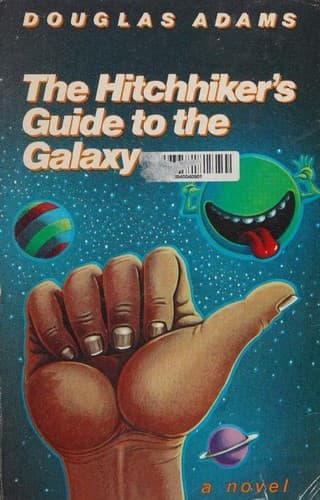
Book details and cover from Google Books.
Ready to read The Hitchhiker's Guide to the Galaxy?
Get your copy on Amazon, or listen to it on Audible. We earn a commission if you buy through these links.