
We earn a commission if you buy through these links. Learn more
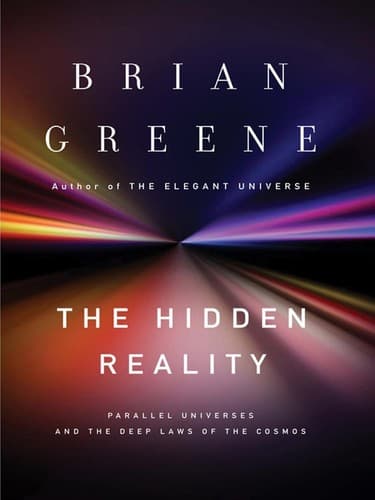
The Hidden Reality
by Brian Greene, Céline Laroche
Guide by the Books of the Day editors · Updated · How we write our guides
Brian Greene's clearest case for a multiverse, separating well-supported physics from speculation so you can judge the big question yourself.
What It's About
The Hidden Reality is Brian Greene's tour of the idea that our universe may be one of many. He walks through a series of proposals from physics and cosmology, arranged roughly from the familiar to the speculative, and asks at each step what the evidence would look like and whether it could ever be tested. It is a popular science book rather than a textbook, and it sits between Greene's earlier accounts of string theory and the harder philosophical questions cosmology raises. The tone is patient and explanatory, with careful analogies and little assumed mathematics.
Much of the pleasure comes from watching one question branch out. Some proposed universes come from inflation in the early cosmos, some from the many configurations string theory allows, and some from the strange logic of quantum measurement. Greene is generally clear about which ideas are well supported, which are speculative, and where physicists disagree, so you finish with a map of the debate rather than a verdict.
The experience is closer to a guided lecture full of wonder than to a thriller. The book moves from spatial intuition to quantum oddity to the question of whether any of this could be observed. Expect to think hard about infinity, probability, and what "real" means in science. It rewards slow reading and a willingness to sit with ideas that do not resolve neatly, though no advanced training is required.
Read this if you…
- are curious about cosmology but do not want a math textbook
- enjoyed Greene's earlier popular physics books and want the next step
- like debates about what counts as evidence in science
Skip it if you…
- want a settled, consensus account of the universe, since much of this is speculative
- need hard data or a detailed grounding in quantum theory
Key Ideas
- 1
Our universe may be one bubble among many
Cosmic inflation, a rapid expansion in the early universe, could have produced separate regions that grew into other universes. Greene explains why this picture arises from well-regarded theory and why it is hard to confirm, since regions beyond our horizon may never send us information.
- 2
String theory multiplies the possibilities
String theory allows a huge number of configurations, each with different physical laws and constants. The book asks whether our particular laws are simply the ones that happen to suit life, and how such a vast set of options could be explored or ruled out by experiment.
- 3
Quantum mechanics may split reality into branches
The many-worlds interpretation holds that every quantum measurement yields all possible outcomes in separate branches. Greene presents this as a serious option, explains why it removes the need for collapse, and is candid that it remains contested among physicists.
- 4
What counts as evidence for an unseen reality
A recurring thread is whether a proposal can be tested at all. Greene keeps returning to the question of what observation would confirm or refute each idea, which makes the book useful for thinking about the limits of science more broadly.
Limitations
Much of the material is untested, so readers who want firm conclusions may find it a catalogue of possibilities. Some find the analogies repetitive and the pace slow in places. Cosmology and quantum foundations have moved on since 2011, so pair the book with newer sources. The book also engages less deeply with critics who question whether these proposals are science at all. The listing credits Céline Laroche as well, but I cannot confirm her role, so this page focuses on Greene's text.
Questions Readers Ask
- Do I need a physics background to read The Hidden Reality?
- No. Greene avoids heavy equations and builds his explanations from analogies and everyday examples. Some concepts, such as quantum measurement and inflation, take real concentration, but a curious adult with a good grasp of basic science can follow the argument.
- Is The Hidden Reality still relevant?
- The central questions remain live debates, but specific theories and observations have changed since 2011. Read it for the conceptual framework and the questions it poses, and check newer books or reviews for current evidence on inflation and string theory.
- How does it compare to Max Tegmark's Our Mathematical Universe?
- Tegmark makes a bolder claim that reality is fundamentally mathematical. Greene is more cautious, surveying several multiverse proposals and separating testable ideas from untestable ones. If you want an argument, try Tegmark; if you want a careful survey, Greene is the better fit.
- Published
- 2011
- ISBN
- 9780307278128
- Difficulty
- intermediate
- Category
- Science
Book details and cover from Google Books.
Ready to read The Hidden Reality?
Get your copy on Amazon, or listen to it on Audible. We earn a commission if you buy through these links.