
We earn a commission if you buy through these links. Learn more
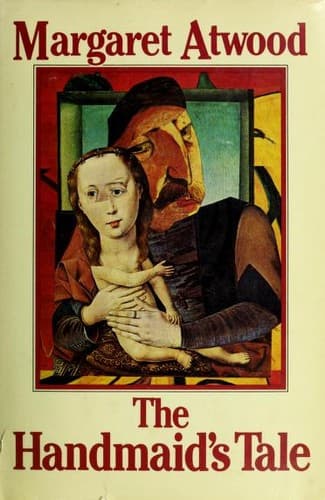
The Handmaid's Tale
On screen: The Handmaid's Tale (TV series, 2017)
Guide by the Books of the Day editors · Updated · How we write our guides
Atwood's chilling 1985 novel of a theocratic America where fertile women are sorted into servants of the state, told in a voice that makes the unthinkable feel uncomfortably plausible.
What Creators Say About The Handmaid's Tale
2 creators reviewed The Handmaid's Tale on YouTube between 2017 and 2018, with 4.1M views between them. Their opinions are their own; we picked these reviews, we didn't write them.
What It's About
The Handmaid's Tale, published in 1985, is set in the Republic of Gilead, a state that has replaced the United States with a rigid religious regime after a crisis of falling birth rates and environmental collapse. Its narrator, known by the name Offred, is one of the handmaids: women whose fertility makes them valuable, assigned to households to bear children for a commander and his wife. The novel is told in her first-person voice, fragmented and reflective, as she moves between memories of her life before and the confinement of her present.
Atwood's approach is quietly unsettling rather than spectacular. Little is explained outright. The world is built through small rituals, forbidden words, rules, and what Offred is and isn't allowed to notice, so the reader pieces together the regime's logic alongside her. The prose is controlled and often lyrical, with wordplay and a bleak dry humor that sits uneasily against the horror. It is a short book that reads quickly, but it lingers.
Reading it feels less like escaping into another world than being handed a mirror. Its cruelties are drawn from historical precedents, which is why it feels so grounded. Many bookshops file it under fantasy, but it is closer to speculative fiction and political warning. It ends with a closing section that reframes the story and changes how the whole thing reads, which is best discovered on your own.
Read this if you…
- want dystopian fiction that prioritizes psychological detail over action
- are interested in how authoritarian regimes justify themselves through religion and bureaucracy
- like a short, precise novel that rewards slow, attentive reading
Skip it if you…
- need a fast-paced plot with clear heroes and an urgent, escape-driven story
- find sexual violence or sustained oppression too distressing to read about in fiction
Key Ideas
- 1
Control of women's bodies as the foundation
The regime's central project is managing reproduction. Handmaids are reduced to their fertility, and the book shows how a state can make that reduction seem orderly, even righteous. Atwood keeps returning to the mechanics of this system: who is allowed to do what with whose body, and how the arrangement is justified in the language of duty and sacred purpose. The horror comes from how bureaucratic it feels.
- 2
Language and ritual as instruments of power
Gilead renames people, scripts greetings, and turns ordinary speech into code. Offred notices how much of her identity lives in words that have been taken away or repurposed. The book argues that authoritarian control works less through force alone than through slowly changing what people are able to say, remember, and imagine. Small verbal habits become a quiet form of obedience.
- 3
Memory and the fragility of ordinary freedom
Offred's recollections of her life before Gilead, including work, marriage, and friendship, are as important as the present-day plot. They show how easily ordinary freedoms were lost and how little people noticed at the time. The back-and-forth structure makes the reader feel the gap between what was normal and what is now unthinkable, and asks how much we take for granted in our own lives.
- 4
Complicity, survival, and small resistance
The novel does not offer heroes in the usual sense. Offred survives by bargaining, hoping, and keeping her head down, and the book examines how ordinary people accommodate injustice to get through each day. Its interest lies in the moral compromises of ordinary people rather than clean acts of rebellion. Readers often find themselves judging her choices and then wondering what they would do.
Limitations
Some readers find the narrator's passivity frustrating, and the novel's refusal to explain how Gilead came to power can feel like a missing piece. The worldbuilding is deliberately sparse, which some critics consider a strength and others a gap. The book's vision of religion and gender is shaped by a particular North American context, and some readers feel its warnings have been applied to it more neatly than the text supports. Its portrayal of sexual violence is direct and may be difficult for some readers.
Questions Readers Ask
- Is The Handmaid's Tale still relevant today?
- Many readers find it more relevant than when it was published, because its concerns about reproductive rights, state control of women, and the erosion of civil liberties keep coming back in public debate. Its arguments are not tied to one decade, though the specific social details reflect the 1980s. Readers often come to it through recent adaptations and then find the novel more restrained and more searching than they expected.
- Should I read The Testaments before or after this book?
- Read this one first. The Testaments, published in 2019, is a sequel that follows different characters and years later in the same world. It builds on the original's events and is more plot-driven. Reading the first novel alone gives you its full effect, and the sequel makes more sense once the original has settled.
- Published
- 1985
- ISBN
- 9781984899668
- Difficulty
- beginner
- Category
- Fantasy
Book details and cover from Google Books.
Ready to read The Handmaid's Tale?
Get your copy on Amazon, or listen to it on Audible. We earn a commission if you buy through these links.