
We earn a commission if you buy through these links. Learn more
The Gruffalo
Guide by the Books of the Day editors · Updated · How we write our guides
A short, rhythmic picture book where a small mouse outwits a line of hungry animals with nothing but his wits, making it one of the best read-aloud books for very young children.
What Creators Say About The Gruffalo
2 creators reviewed The Gruffalo on YouTube in 2024, with 6.8M views between them. Their opinions are their own; we picked these reviews, we didn't write them.
What It's About
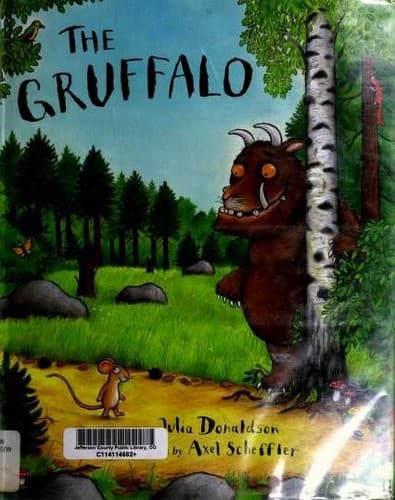
The Gruffalo is a picture book for very young children, first published in 1999, with text by Julia Donaldson and illustrations by Axel Scheffler. A small mouse walks through a wood and meets a series of larger animals who want to eat him. His answer is to describe a monster he says he is meeting, and the book follows the rhythm of that talk as it moves through the forest.
The approach is built for reading aloud. The verse runs in tight, bouncy rhyming couplets with a repeated refrain that children start chanting by the second reading. The pictures carry much of the humour and suspense, with the animals' expressions doing work the words leave out. It is short, so it works as a bedtime book or a first story for a child who is only beginning to follow a plot.
Reading it is a light, playful experience for adults too. The tension is gentle, the ending is satisfying without being cruel, and the idea of a small creature talking his way out of trouble lands well with children who like to feel clever. Expect to read it many times. The rhythm is the point, and it rewards a reader who can do the voices.
Read this if you…
- want a first picture book with a strong rhythm to read aloud
- have a young child who enjoys being a little scared and then reassured
- want a short story with a small, clever hero that rewards repeated readings
Skip it if you…
- want a story with a detailed plot, complex characters, or emotional development
- are looking for a book to build independent reading skills, since the rhythm does most of the work
Key Ideas
- 1
Cleverness as a survival tool
The mouse has no strength or speed to protect himself, so he relies on wit and storytelling. The book quietly argues that talking carefully can be as powerful as fighting, and young readers tend to feel rewarded by that idea rather than lectured about it.
- 2
Rhythm and rhyme as the engine
The text is written to be performed. Its couplets, steady beat, and repeated refrain make the story predictable in the best sense, so children can join in and anticipate what comes next. Much of the book's pleasure lives in the sound of it as much as the plot.
- 3
Pictures that carry the suspense
Axel Scheffler's illustrations show what the mouse does not say, including the reactions of the animals he encounters. Children learn to read faces and body language alongside the words, which makes the book a useful first step in visual storytelling.
- 4
Fear handled through humour
Danger is present, since predators are hunting the mouse, but it is framed comically and resolved with reassurance. That balance suits small children who want a little excitement without real distress, and it gives adults an easy way to talk about being scared and staying calm.
Limitations
The rhyme is intentionally sing-song, and some adults find it wearing after many readings. The characters are types rather than people, so there is little psychological depth for older readers to discuss. The premise depends on a single bluffing device, and the book does not try to do more than that. It is also very short, which is a strength for toddlers but may feel slight to a child who has moved on to longer stories. Parents of especially sensitive children may want to preview the predator scenes first.
Questions Readers Ask
- Is The Gruffalo suitable for reading alone?
- It is best suited to reading aloud, usually to children from about three to six. Confident early readers can manage the text, but the book's appeal depends on performance: the voices, the pauses, and the rhythm. Many children enjoy taking turns with a parent or sibling on the repeated lines.
- What should I read after The Gruffalo?
- The Gruffalo's Child, which follows the same creators and returns to the forest with a new central character, is the natural next step. Julia Donaldson's other rhyming picture books, such as Room on the Broom, share the same read-aloud appeal and are a good choice for children who want more of this style.
- Published
- 1999
- ISBN
- 9781845025038
- Difficulty
- beginner
- Category
- Children's Books
Book details and cover from Google Books.
Ready to read The Gruffalo?
Get your copy on Amazon, or listen to it on Audible. We earn a commission if you buy through these links.