
We earn a commission if you buy through these links. Learn more
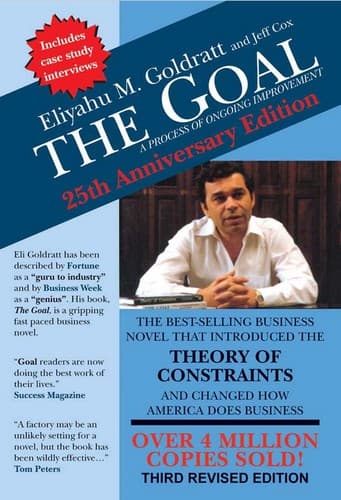
The goal
by Eliyahu M. Goldratt, Jeff Cox
Guide by the Books of the Day editors · Updated · How we write our guides
A plant manager facing closure learns the logic of bottlenecks in a novel that has shaped how operations people think about waste and flow.
What Creators Say About The goal
2 creators reviewed The goal on YouTube between 2016 and 2023, with 33.7K views between them. Their opinions are their own; we picked these reviews, we didn't write them.
What It's About
The Goal is a business novel, first published in 1984, that follows Alex Rogo, the manager of a struggling manufacturing plant. Corporate headquarters gives him a short window to show improvement or face closure. Eliyahu Goldratt and Jeff Cox use the story as a vehicle for what Goldratt called the Theory of Constraints. Rather than a textbook, you get a sequence of meetings, arguments, shop-floor crises, and strain at home, with the ideas arriving through a mentor who asks Alex pointed questions.
The writing is plain and fast. Characters are sketched more than developed, and dialogue often exists to carry an argument. That is a strength for readers who want the concepts quickly and a weakness for those who want a rich novel. The book reads in an evening or two, and much of its pleasure comes from watching familiar workplace habits, like judging machines by how busy they look, get taken apart.
The experience is less a story to get lost in than a problem you work through alongside the protagonist. Many readers finish it wanting to look at their own workplace differently, which is the authors' intent. It works best as a first encounter with operations thinking, and it leaves the technical detail to later books.
Read this if you…
- want a fast, concrete introduction to operations or process improvement
- suspect your team's metrics reward the wrong behavior and want a clear way to argue about it
- prefer business books that teach through a story rather than a stack of frameworks
Skip it if you…
- want a deeply drawn novel with complex characters and rich prose
- need the detailed scheduling mechanics of the method; this book only introduces the core logic
Key Ideas
- 1
Every system has a single constraint
Any process, whether a factory line or a sales pipeline, is limited by one resource that holds everything else back. The central lesson is that improving anything other than that bottleneck mostly wastes effort. The book trains you to find the constraint first, because it sets the pace for the whole system and therefore determines where improvement actually shows up in results.
- 2
Local efficiency can damage the whole
Keeping every machine and worker busy feels productive, but running non-bottleneck resources at full speed just piles up unfinished inventory. The authors argue that this creates cost without adding output. Readers will recognize the trap of optimizing departments separately, and the book makes a persuasive case for judging each choice by its effect on the entire flow.
- 3
Measure by throughput, inventory, and operating expense
Goldratt proposes three plain measures: how fast money comes in through sales, how much money is tied up in stock, and what it costs to run the operation. Defining these clearly is meant to keep managers from chasing numbers that look good locally. The framing is simple enough to apply outside manufacturing, though the translation takes some effort.
- 4
A repeating process for focused improvement
The book lays out a short sequence: identify the constraint, decide how to get the most from it, align everything else to support it, raise its capacity if needed, and then look for the new constraint that emerges. The loop is the practical takeaway. It turns a one-time fix into an ongoing habit, which is why many operations teams still use it as a starting framework.
Limitations
Critics often note that the characters are thin and the dialogue can feel didactic, as if written to deliver a lesson. The book leaves out most implementation detail, which the authors addressed in later titles. Its manufacturing focus means software, service, or knowledge-work readers must translate the ideas themselves. Some of its success claims rest on anecdote and the authors' own consulting work, so treat results as illustrative rather than proven. The prose style and factory setting also show their age.
Questions Readers Ask
- Is The Goal still relevant if I don't work in a factory?
- Yes, many readers apply its core ideas to software teams, hospitals, and service businesses. The challenge is translation, since the examples are physical production. Ask where work piles up and which step limits everything downstream. That question carries over well, even though the specific measures need adapting to your setting.
- Should I read the sequels or Goldratt's later books?
- Goldratt and Cox followed with a sequel, It's Not Luck, which continues Alex's story. Goldratt later wrote more technical books such as Critical Chain on project scheduling. Read The Goal first, since it gives the foundation the later books assume, and then decide whether you need more detail.
- How does it compare to books about Lean or Toyota's production system?
- Lean books focus heavily on eliminating waste across a whole process. The Goal focuses on finding the single constraint that limits output. Many readers find the two approaches complementary, with The Goal offering a sharper decision rule about where to start improving.
- Published
- 1986
- ISBN
- 9781622313945
- Difficulty
- beginner
- Category
- Business
Book details and cover from Google Books.
Ready to read The goal?
Get your copy on Amazon, or listen to it on Audible. We earn a commission if you buy through these links.