
We earn a commission if you buy through these links. Learn more
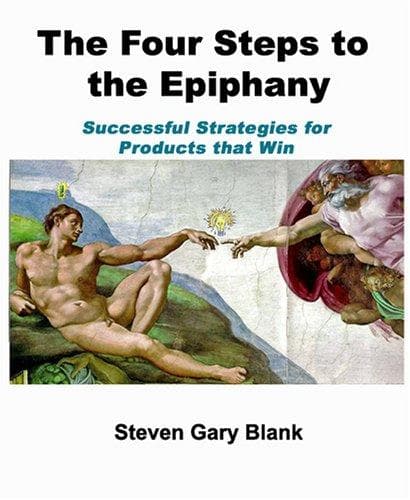
The Four Steps to the Epiphany
Guide by the Books of the Day editors · Updated · How we write our guides
A dense but influential playbook for founders that treats a startup as a search for a business model, and tells you to test every assumption with customers before building.
What Creators Say About The Four Steps to the Epiphany
2 creators reviewed The Four Steps to the Epiphany on YouTube between 2015 and 2023, with 7.7K views between them. Their opinions are their own; we picked these reviews, we didn't write them.
What It's About
The Four Steps to the Epiphany is Steve Blank's attempt to turn his experience launching and advising technology companies into a repeatable method. Its central move is to argue that a startup is not a small version of an established company running a known plan. It is a temporary organization searching for a business model that works, and that search has to be conducted through direct contact with real customers rather than inside a product team's assumptions. The book organizes this process into four steps: customer discovery, customer validation, customer creation, and company building.
The style is practical and sometimes repetitive. Blank writes like a teacher working through a course, introducing a concept, illustrating it, then returning to it from another angle. Much of the text covers how to structure customer conversations, how to recognize when a hypothesis has failed, and how a founder should decide whether to change direction. Diagrams and checklists carry a lot of the weight, and the reader is expected to apply the ideas to their own venture as they go.
Reading it feels less like following a story and more like sitting in on a seminar where you need to take notes. Many readers come away with a sharper sense of what they still do not know about their market. Founders who want to skip the early discovery work will find the book's insistence on it uncomfortable, and that discomfort is largely the point.
Read this if you…
- are building or planning a technology startup and want a structured way to test assumptions before spending heavily
- want to understand the original thinking behind lean startup methods and customer development
- suspect that the playbook for running an established business does not work for a company still searching for its market
Skip it if you…
- want a memoir or a narrative account of founders' lives and struggles
- are looking for guidance on running a mature company, managing finances, or leading a large organization
Key Ideas
- 1
A startup is a search, not an execution
Blank's foundational claim is that a new company begins without a proven business model, so its job is to find one. Established firms execute a plan they already understand, while startups are still discovering who the customer is, what they want, and how the company will make money. Seeing the work this way changes what counts as progress. Early success is measured by validated learning, not by shipped features or headcount.
- 2
Get out of the building
The book's most quoted instruction in spirit is that founders should spend substantial time talking to potential customers, partners, and users outside the office. Blank argues that opinions formed in a conference room are untested guesses. Direct conversation exposes wrong assumptions early, when they are cheap to fix. The book treats this as a discipline with its own methods rather than a vague recommendation to be more customer-focused.
- 3
Customer development alongside product development
Blank separates the work of building the product from the work of understanding the market, and he argues that both need their own process running in parallel. Product teams focus on what to build, while the customer development process tests who will buy it and why. Keeping the two distinct prevents a company from polishing something no one wants. It also gives founders a structured way to decide when the product is ready for broader launch.
- 4
Pivots as a response to evidence
The book gives serious attention to the idea that a startup may need to change direction when its hypotheses fail. Blank treats a pivot not as an admission of defeat but as a deliberate change in strategy driven by what customers have shown. The value of this framing is that it gives founders language and criteria for deciding when to persist and when to change course, rather than relying on instinct or stubbornness.
Limitations
The book's examples come largely from the mid-2000s technology sector, and some of its tools and assumptions reflect that period. Its prose is often repetitive and can feel padded, with the same points restated across chapters. The framework is oriented toward software and internet businesses, so readers in consumer goods, hardware-heavy ventures, or regulated industries will need to adapt it considerably. Later books, including Blank's own work with Bob Dorf and Eric Ries's The Lean Startup, explain similar ideas more concisely and with more accessible language.
Questions Readers Ask
- Is The Four Steps to the Epiphany still relevant for startups today?
- Yes, mainly for its core logic. The specific examples and tools are dated, but the insistence on testing assumptions with real customers before scaling remains central to how many founders work. Readers should treat the four steps as a mental model rather than a fixed checklist, and expect to update the surrounding details to match current markets and technology.
- How does it compare to The Lean Startup?
- Eric Ries built directly on Blank's customer development work, and The Lean Startup is the more accessible and widely read book. Blank's book goes deeper into the mechanics of customer discovery and is written more like a practitioner's manual. If you want a quick, memorable introduction, start with Ries. If you want the fuller method behind it, Blank is the source.
- Published
- 2005
- ISBN
- 9780976470700
- Difficulty
- intermediate
- Category
- Business
Book details and cover from Google Books.
Ready to read The Four Steps to the Epiphany?
Get your copy on Amazon, or listen to it on Audible. We earn a commission if you buy through these links.