
We earn a commission if you buy through these links. Learn more
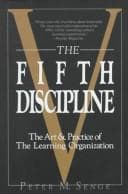
The Fifth Discipline
by Peter Senge, Peter M. Senge
Peter Senge's 1990 classic makes a serious case that organizations can learn, and that systems thinking explains why good intentions so often backfire. It rewards patient readers more than quick ones.
What It's About
The Fifth Discipline is a 1990 management book arguing that organizations, like people, can learn, and that most fail to learn well because they are built around narrow jobs and blame outside forces for their problems. Senge, a professor at MIT's Sloan School of Management, presents a framework he calls the learning organization, built on five disciplines. The book is less a how-to manual than an argument that leaders should change how they think about cause and effect.
Its approach mixes conceptual argument, case stories drawn from businesses Senge worked with, and simple diagrams of feedback loops. Some chapters are dense and depend on the reader working through the diagrams; others read like a consultant's reflective essay. The style is earnest and occasionally repetitive, often circling back to the same points with new examples.
Reading it feels like being slowly pulled into a new vocabulary. The most lasting part is the systems thinking discipline, which trains you to spot the feedback loops and time delays behind recurring problems. The rest may feel familiar to anyone who has encountered later management thinking, but the central question still lands: why do capable people in organizations so often produce results nobody wanted?
Read this if you…
- are a manager or team leader who keeps seeing the same problems return
- want a conceptual foundation for organizational change before adopting specific tools
- enjoy slow, reflective business writing and are willing to work through diagrams
Skip it if you…
- want a practical, step-by-step playbook with clear metrics and checklists
- are looking for current research on organizations, since the evidence is mostly case-based and dated
Key Ideas
- 1
Systems thinking as the integrating discipline
Senge treats seeing wholes and relationships as the discipline that ties the others together. He argues that many problems come from the structure of a situation rather than from individual failings, and that delays and feedback loops explain why well-meant fixes often make things worse. The book introduces recurring structural patterns, which it calls system archetypes, as a way to recognize trouble early.
- 2
Personal mastery as ongoing practice
Personal mastery is the commitment to clarifying what you truly want and seeing your current reality honestly. Senge frames it as a practice you keep up rather than a fixed personality trait, and he ties it to the tension between a personal vision and the way things currently stand. It is the individual foundation for everything that follows.
- 3
Mental models that quietly shape behavior
People act on assumptions they often never examine, and those assumptions determine what they notice and what they do. Senge argues that surfacing and testing these beliefs, especially in group conversation, is necessary before any change in an organization will stick. Without that work, new programs tend to be absorbed into old habits.
- 4
Shared vision and team learning
A shared vision is a picture of a future that people actually want to create together, not a mission statement handed down from above. Team learning is the group's ability to think together through dialogue, setting aside certainty, so that the collective intelligence can exceed that of any single member. Senge sees both as essential to sustained organizational change.
Limitations
Much of the book's evidence is anecdotal, drawn from consulting cases and Senge's own experience, so many of its claims are hard to test. The learning organization can sound more like an aspiration than a design you can build, and critics note that the concept is vague about how to measure progress. The examples and management language reflect the early 1990s, and parts of the organizational context feel dated. Senge's later books and the companion fieldbook offer more practical tools.
Questions Readers Ask
- Is The Fifth Discipline still relevant today?
- Parts of it are, especially the systems thinking chapters, which still help explain why interventions in complex organizations produce unexpected side effects. The specific examples and corporate language are dated, and the book predates much of modern agile and digital management. Treat it as a foundation for thinking rather than a current guide to practice.
- How does it compare to The Goal by Eliyahu Goldratt?
- The Goal is a novel that teaches constraint thinking through a plant manager's story, and it is much faster to read. The Fifth Discipline is broader and more abstract, covering personal and team learning as well as systems. Choose The Goal for a gripping introduction to bottlenecks, and Senge if you want to think about how people and organizations learn.
- Published
- 1990
- ISBN
- 9780553473216
- Difficulty
- intermediate
- Category
- Business
Book details and cover from Google Books.
Ready to read The Fifth Discipline?
Get your copy on Amazon, or listen to it on Audible. We earn a commission if you buy through these links.