
We earn a commission if you buy through these links. Learn more
The Feeling of What Happens
Damasio argues that consciousness starts with the body sensing itself, making this a rare, serious attempt to explain how feeling becomes a sense of self.
What It's About
The Feeling of What Happens is Antonio Damasio's 1999 attempt to explain consciousness through the body rather than through abstract reasoning about the mind. Damasio, a neurologist who studies patients with brain damage, starts from a simple but often overlooked claim: the sense that you are a self aware of the world depends on the brain continuously mapping the state of the body. He builds his case step by step, moving from basic awareness to a fuller autobiographical self.
The writing is more discursive than the textbook neuroscience it draws on. Damasio mixes clinical case material, evolutionary reasoning, and interpretation of brain-imaging findings of his era, and he often pauses to define his terms, such as what he means by feeling or by self in this context. Expect a book that circles back to its key distinctions rather than racing toward a single proof. Read it slowly and with a notebook, because the argument accumulates.
The experience is closer to following a careful thinker's argument than to reading a popular science book with tidy takeaways. If you come for a neat answer to the hard problem of consciousness, you will be disappointed; the book offers a detailed map of where feeling might arise, not a settled explanation. That modesty is part of its appeal for readers who want to think alongside the author.
Read this if you…
- are curious how the brain turns sensation into a sense of self
- enjoy careful, step-by-step arguments more than quick takeaways
- already know some neuroscience and want a major theory of consciousness
Skip it if you…
- want a clear answer to the hard problem of consciousness
- need practical self-help advice on managing emotions
Key Ideas
- 1
Consciousness is built on bodily signals
Damasio argues that feeling begins with the brain representing the state of the body from moment to moment, including internal organs, muscles, and chemistry. Rather than treating the mind as a detached observer, he treats awareness as grounded in these bodily maps. This is the foundation for the rest of his case, and it is why the book reads as a challenge to purely mental accounts of the self.
- 2
Core and extended consciousness as layers
The book's central division separates a momentary core consciousness, which gives a sense of a self in the here and now, from an extended consciousness that builds a richer sense of a person with a past, identity, and future. Damasio treats these as layers rather than an either-or choice. The framework is useful for organizing the argument, though the boundary between the layers is not always sharp.
- 3
Emotion and feeling are separate processes
Damasio distinguishes emotion, the body's automatic responses to situations, from feeling, our perception of those responses. Emotions show up in the body and can be observed from outside, while feelings are the mind registering them. He develops this distinction at length to explain why emotion is not a distraction from reason but part of how the mind assesses what matters.
- 4
The autobiographical self and its memories
Extended consciousness depends on memory and a sense of ongoing identity. Damasio describes how the brain assembles a record of a person's history and anticipations, linking that record to the moment-to-moment body sense. Some readers find this the most personal section of the book, though it is also the most speculative.
Limitations
The book is now more than two decades old, and neuroscience has moved on, particularly in imaging methods and in the study of consciousness itself. Critics argue that Damasio's core and extended model is more a useful organizing scheme than a tested account, and that terms like feeling and self are used in ways that can be slippery. The book also says little about non-human minds or the social and cultural shaping of emotion, and its evolutionary stories are hard to verify.
Questions Readers Ask
- Is The Feeling of What Happens still relevant today?
- Yes, as a historical and conceptual text, though not as a current guide to the science. Its central proposal, that consciousness is grounded in bodily feeling, remains a serious position that researchers still debate. The specific brain-mapping details and some terminology have been superseded, so pair it with newer reviews if you want the current state of the field.
- How does it compare to Descartes' Error?
- Descartes' Error, Damasio's earlier book, makes the case that emotion supports good reasoning, and it is more accessible and narrower in scope. The Feeling of What Happens goes further, attempting a full account of consciousness and the self. Read Descartes' Error first if you are new to his work; this one rewards readers who already know his ideas.
- Who is this book best suited to?
- Readers with some background in psychology, philosophy of mind, or neuroscience will get the most out of it. General readers who are patient with technical language can also manage it, especially if they read slowly. It is less suited to anyone wanting a short overview, since the argument unfolds across a long, careful build.
- Published
- 1999
- ISBN
- 9780151003693
- Difficulty
- intermediate
- Category
- Psychology
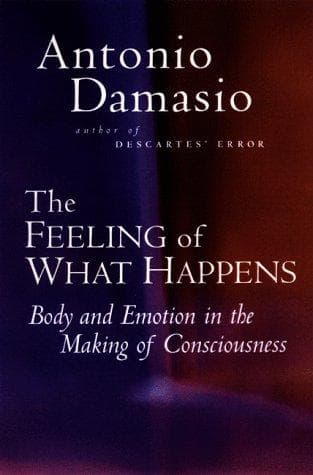
Book details and cover from Google Books.
Ready to read The Feeling of What Happens?
Get your copy on Amazon, or listen to it on Audible. We earn a commission if you buy through these links.