
We earn a commission if you buy through these links. Learn more
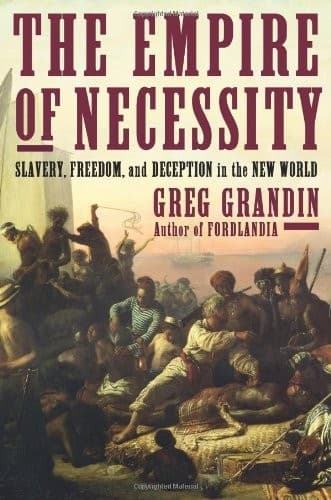
The Empire of Necessity: Slavery, Freedom, and Deception in the New World
A close reading of one bizarre 1805 encounter at sea becomes a sharp argument about how empires justify themselves as necessary, and how freedom and slavery were built together.
What It's About
The Empire of Necessity starts with a small, strange episode. In 1805 Captain Amasa Delano, an American sealer, boarded a Spanish ship off the coast of Chile where enslaved Africans had taken control. Delano misread the situation, and his published account of the voyage later became the raw material for Herman Melville's novella Benito Cereno. Greg Grandin uses that account to ask how a fairly decent man could see so little, and what his blind spots reveal about the era.
From that single deck, Grandin widens the frame to the wider Atlantic and Pacific world of the early nineteenth century. He moves between the Haitian Revolution, the slave economies of the Americas, the collapse of Spanish rule, and the expansion of the United States. His central claim is that the language of liberty and the logic of compulsion were tangled together, and that empires often present their conquests as the only available option rather than as choices. The book reads as part narrative history, part close reading of documents and fiction, and part sustained political argument.
The experience is rewarding but demanding. Grandin's argument builds cumulatively rather than resolving neatly in each chapter, and readers should be ready to follow connections across regions and sources. If you enjoy seeing archives and literature speak to each other, it repays careful attention.
Read this if you…
- want a history that uses one ship's encounter to explain larger Atlantic and American politics
- already know Melville's Benito Cereno and want its historical background
- are interested in how the early United States justified its expansion
Skip it if you…
- want a fast, narrative-driven story with a clear chronology
- are looking for a general survey of the slave trade or the abolition movement
Key Ideas
- 1
A misread encounter as a window
Delano's failure to grasp what was happening aboard the ship becomes a case study in how assumptions, hierarchy, and self-image shape what observers are willing to see. Grandin treats his narrative not as a neutral report but as a document that reveals the mindset of a slaveholding world.
- 2
Necessity as the justification of empire
Grandin argues that imperial expansion was repeatedly framed as something forced on rulers by circumstance, not something they chose. This self-justifying idea of necessity helps explain how violence could be presented as regrettable but unavoidable, and why it kept recurring.
- 3
Freedom and bondage as entangled
The book insists that the republics and liberal ideals of the period were not opposed to slavery but developed alongside it. Liberty for some was often defined against, and depended upon, the unfreedom of others, a tension the book traces across several regions.
- 4
Literature as a counter-record
Melville's Benito Cereno rewrites Delano's story to expose what the captain could not see. Grandin uses the novella alongside the historical record to show how fiction can reveal the moral and political blind spots that official accounts leave in place.
Limitations
Critics have questioned how far a single voyage can carry such a broad argument, and some readers find Grandin's connections between events more sweeping than the evidence strictly allows. Because Delano's account is written from the captain's point of view, the enslaved people who acted on the ship are visible mainly through sources shaped by their captors. The book is an interpretive argument rather than a comprehensive history of slavery, empire, or the revolutions of the period, so readers wanting broad coverage will need to look elsewhere.
Questions Readers Ask
- Do I need to know Benito Cereno before reading it?
- No. Grandin introduces the Delano account and the novella's relationship to it, so you can follow the book without prior knowledge. Reading Melville's story first does add a useful layer, since the book often returns to how the novella reframes the historical episode.
- Is this book still relevant to debates about American empire?
- Yes, many readers find its argument about necessity as a justification for expansion useful for thinking about later American interventions. The book is most valuable as an interpretation of how such justifications work, rather than as a guide to contemporary policy.
- How does it compare to other histories of slavery in the Americas?
- It is narrower in scope than broad surveys and more interpretive than many archival studies. If you want a wide overview, pair it with a general history. If you want a sharp argument about ideology and empire, it stands out for its focus on a single encounter.
- Published
- 2014
- ISBN
- 9781780744100
- Difficulty
- intermediate
- Category
- History
Book details and cover from Google Books.
Ready to read The Empire of Necessity: Slavery, Freedom, and Deception in the New World ?
Get your copy on Amazon, or listen to it on Audible. We earn a commission if you buy through these links.