
We earn a commission if you buy through these links. Learn more
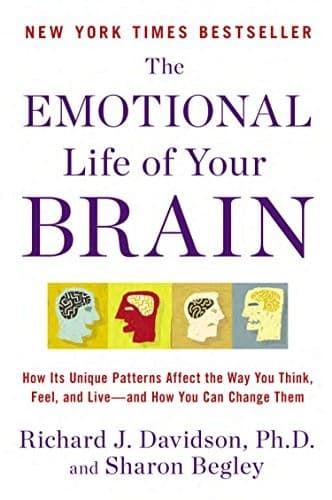
The emotional life of your brain
Richard Davidson, a leading neuroscientist, explains six measurable dimensions of 'emotional style' and argues that brain circuits behind them can change with practice.
What It's About
The Emotional Life of Your Brain is written by Richard J. Davidson, a neuroscientist who has spent decades studying how emotion shows up in the brain, with science writer Sharon Begley. Its central move is to treat emotion less as a mood that happens to you and more as a set of stable tendencies that differ from person to person. Davidson calls these an individual's emotional style and describes how it can be measured, using everyday terms rather than lab jargon.
The book is organized around the brain systems involved in feeling and regulating emotion, especially the amygdala and the prefrontal cortex, and how their interaction shapes how quickly we react, how long we stay upset, and how we read other people. The author draws on his own research and on studies of meditation practitioners, using these to argue that emotional habits are trainable. It reads as a mix of accessible science and personal reflection rather than a self-help manual, though it does include practical suggestions.
The experience is a steady, thoughtful walk through research rather than a fast read. You will come away with a useful vocabulary for your own reactions and a sense of which parts of your emotional life are wiring and which are choices. Expect detailed explanations of studies and mechanisms, and be prepared to slow down in the middle chapters.
Read this if you…
- want a research-based way to understand why you react to stress the way you do
- are curious how neuroscience explains emotional differences between people
- are interested in whether meditation and mental training have measurable effects on the brain
Skip it if you…
- want a short, practical self-help book with quick exercises you can finish in a weekend
- prefer memoir or narrative storytelling over studies and scientific explanation
Key Ideas
- 1
Emotional style is a measurable personal profile
Davidson proposes that people differ systematically in how they respond emotionally, much as they differ in temperament. Instead of asking whether someone is 'an emotional person,' he breaks the question into distinct dimensions, so you can see where your own tendencies sit and how they might differ from those of people close to you.
- 2
Six dimensions shape everyday emotional life
The book organizes emotional style around dimensions such as resilience, outlook, social intuition, self-awareness, sensitivity to context, and attention. Each describes a different way emotion plays out, from how fast you recover after a setback to how well you pick up on other people's feelings. The framework gives readers a practical checklist for self-observation.
- 3
Brain circuits underlie emotional habits
A recurring theme is that emotional responses rely on identifiable circuits linking deep structures such as the amygdala with regions of the prefrontal cortex that regulate them. Davidson explains how the strength and balance of these connections help account for why some people bounce back quickly and others stay stuck, without reducing people to their wiring.
- 4
Emotional patterns can be trained
Perhaps the most hopeful argument is that the brain remains plastic, so emotional habits can shift with sustained practice. Davidson draws on research into meditation and related training to suggest that attention and emotional regulation can be strengthened, though he is careful about how large and how quick such changes are.
Limitations
Some readers find the book leans heavily on the author's own laboratory and on a relatively small set of studies, which makes its claims feel more settled than the wider literature supports. The meditation research in particular involves small samples and is hard to generalize. The book also gives limited attention to how culture, trauma, and economic circumstances shape emotional life, and it does not offer clinical guidance for anxiety or depression. Parts of the neuroscience have been refined by later research, so the specifics should be read as a snapshot rather than a final word.
Questions Readers Ask
- Is this book good for someone with no background in neuroscience?
- Yes, mostly. Davidson avoids heavy technical language and explains brain structures in plain terms. Some chapters on circuitry and study design require more concentration, but a general adult reader can follow the central ideas without prior training in the field.
- Is the book still relevant given how fast the field has moved?
- The core framework of emotional style and the idea of trainable regulation remain useful for thinking about emotion. Some specific findings and brain-imaging interpretations have been revised since publication, so treat the details as a starting point and check newer research on topics that matter to you.
- How does it compare with Daniel Goleman's Emotional Intelligence?
- Goleman's book is broader and more popular, focusing on emotional intelligence in work and relationships. Davidson's book is narrower and more scientific, concentrating on measurable emotional style and the brain systems behind it. Read Goleman for practical framing and Davidson for the research behind it.
- Published
- 2012
- ISBN
- 9780452298880
- Difficulty
- intermediate
- Category
- Psychology
Book details and cover from Google Books.
Ready to read The emotional life of your brain?
Get your copy on Amazon, or listen to it on Audible. We earn a commission if you buy through these links.