
We earn a commission if you buy through these links. Learn more
The Elements
Guide by the Books of the Day editors · Updated · How we write our guides
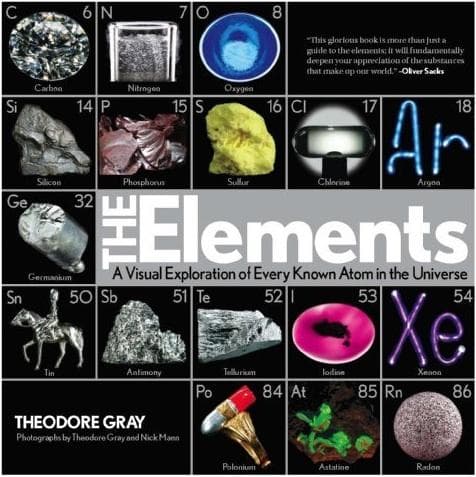
A visual tour of the periodic table in which each element gets a photograph of a real sample, plus notes on its history and everyday uses.
What Creators Say About The Elements
2 creators reviewed The Elements on YouTube between 2017 and 2022, with 12.9K views between them. Their opinions are their own; we picked these reviews, we didn't write them.
What It's About
The Elements is built around a simple idea: take the periodic table, which most people only see as a grid of letters in a classroom, and show what each entry actually looks like. Theodore Gray photographed samples of the elements, many of them sealed in glass, and placed each one beside a short essay covering its physical character, how it was first isolated or identified, and where it turns up in daily life or industry. The result is less a textbook than a browsable object you return to and open at random.
Each element gets roughly a page, and the layout keeps the tone consistent: a striking photo, a compact set of facts, and a paragraph or two of narrative. Some entries cover familiar materials like iron or carbon, where the interest lies in surprising uses. Others cover rare, unstable, or radioactive elements that most readers will never handle, and there the photographs become a rare window onto substances that otherwise exist mainly as symbols. Gray's prose is plain and conversational, and he is willing to say when a sample is more a curiosity than a useful material.
Reading it feels like walking through a well-stocked museum of matter rather than studying for an exam. You won't come away with a working command of chemistry, and the book doesn't try to teach you how to balance equations or predict reactions. What you get is a physical sense of the table: the metals that are heavy and dull, the gases you could never see, and the odd fact that stops you mid-page. It rewards dipping in over a few weeks.
Read this if you…
- are curious about what everyday materials actually are
- want a browsable visual reference you can open at random
- enjoyed science class but never really pictured the periodic table as stuff
Skip it if you…
- need a rigorous chemistry textbook with equations and problem sets
- want a continuous narrative history rather than entries organized element by element
Key Ideas
- 1
The periodic table as a map of real stuff
The book turns an abstract chart into physical objects. Seeing each element as a real substance with its own color, weight, and texture makes the table's organization feel less arbitrary. Patterns in the grid start to correspond to things you could, in principle, pick up and examine.
- 2
Familiar substances hide surprising histories
Common elements such as carbon, iron, and copper have long stories of discovery, use, and gradual understanding. The book shows how materials people have worked with for centuries shaped technology and everyday objects, and how much of that was not obvious until recently.
- 3
Rare and dangerous elements, shown up close
Many elements are scarce, reactive, or radioactive, and most readers will never encounter them in person. Gray explains why these are hard to handle and why a photograph may be the only realistic way to see some of them. This section gives the table a sense of range and difficulty.
- 4
Naming, discovery, and an unfinished table
The table grew over time through a mix of natural discovery and laboratory synthesis. Some entries touch on disputed credit and changing names. The book reminds readers that the table is a human project still being extended, not a finished list handed down.
- 5
Properties explained without heavy math
Ideas such as density, color, and reactivity are introduced in plain language rather than through equations. Readers get enough of the underlying logic to understand why an element looks or behaves as it does, without needing a background in physical chemistry.
Limitations
The book is organized element by element, so it reads more like a collection of essays than a connected story, and repetitive stretches are possible if you read it straight through. Its emphasis on photographs and anecdotes means it explains less theory than a textbook would. Because it was published before the most recent additions to the periodic table, its coverage of the newest synthetic elements is incomplete, so check which edition you are buying. Some readers also find the large-format print edition expensive for the amount of text.
Questions Readers Ask
- Is The Elements still relevant given newer elements?
- The core facts about established elements remain sound, and the photographs are the main draw regardless of date. However, the table has since been extended with synthetic elements that were named in 2016, and the original text does not cover them in full. Read it as a strong foundation rather than a complete current reference.
- How does it compare to a chemistry textbook?
- A textbook explains why elements behave as they do through theory, equations, and worked problems. This book focuses on what the elements look like, where they came from, and how they are used. The two work well together, with this one supplying the physical picture and a textbook supplying the reasoning.
- Published
- 2009
- ISBN
- 9781579128142
- Difficulty
- beginner
- Category
- History
Book details and cover from Google Books.
Ready to read The Elements?
Get your copy on Amazon, or listen to it on Audible. We earn a commission if you buy through these links.