
We earn a commission if you buy through these links. Learn more
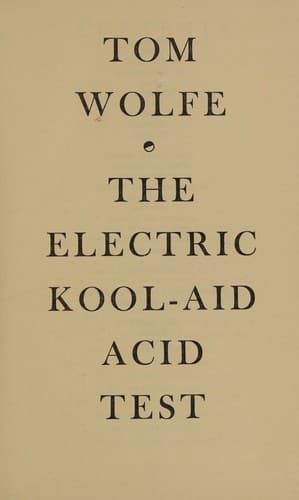
The Electric Kool-Aid Acid Test
by Tom Wolfe
Tom Wolfe's wild, kaleidoscopic account of Ken Kesey's LSD-fueled Merry Pranksters shows 1960s counterculture from the inside, in a style that reads like a fever dream.
What It's About
The Electric Kool-Aid Acid Test follows Ken Kesey, the author of One Flew Over the Cuckoo's Nest, and the group of friends known as the Merry Pranksters. In 1964 they set off across the United States in a painted bus, and later they held public LSD parties called Acid Tests. Wolfe spent time with them and writes about them the way a participant-observer might, moving between scenes, voices, and moods rather than telling one tidy life story. The result covers the years of the bus trip, the parties, and the growing public attention that followed.
The prose is the main event. Wolfe uses typographic tricks, sound effects, long run-on sentences, italics, and stretches of dialogue with almost no attribution, so the page often mimics the disorientation of the drug experience and the chaos of the gatherings. Reading it feels closer to riding along than to studying a history. Some passages are hilarious, some are unsettling, and the rhythm can feel relentless across a full book's length.
What you get is less a settled verdict on the 1960s than a snapshot of how the scene felt from inside, filtered through Wolfe's sharp eye for status, costume, class, and performance. The book ends up asking as much about the reporter's own position as about the people he describes, which is part of why it still gets argued over.
Read this if you…
- are curious about how the 1960s counterculture actually felt from the inside
- enjoy vivid, experimental nonfiction and want to see what New Journalism could do
- want a portrait of a restless group rather than a tidy biography of a single person
Skip it if you…
- want a clear, chronological history of the 1960s or of early LSD research
- find breathless, stylized prose tiring over a long stretch
Key Ideas
- 1
Perception as the central subject
Wolfe treats altered states as a way of seeing, not just a backdrop. He tries to convey what sensation, repetition, and noise do to attention and memory, and he asks readers to take the Pranksters' inner world seriously even when it looks absurd from outside.
- 2
A reporting style that breaks the rules
This book is a showcase for New Journalism, the mid-century movement that borrowed the tools of fiction for factual writing. Wolfe uses scene, dialogue, and point of view to build a story, and he experiments with layout and sound on the page in ways a conventional news report never would.
- 3
Community built through shared self-invention
The Pranksters are shown making their own rules, slang, and mythology. Wolfe is interested in how a small group creates an identity through repeated rituals, props, and stories, and how that identity holds them together while also making them hard to pin down.
- 4
Counterculture as a display of status
Wolfe repeatedly notices how rebellion has its own hierarchies, costumes, and social codes. He reads the scene partly as a performance for an audience, which gives the book a satirical edge alongside its sympathy.
- 5
The fragility of a movement
The energy of the bus trip and the Acid Tests cannot last forever. Legal trouble, changing audiences, and internal strain show how quickly a loose, improvised community can scatter, and the book carries a quiet sense of that coming end.
Limitations
The book's style is its strength and its main obstacle. Wolfe's rapid, sensory prose can blur details, and critics have questioned how closely some scenes match what actually happened, since the account leans on his perspective and the Pranksters' own storytelling. Women and other members of the scene receive relatively little space compared with Kesey and the core group. Wolfe's ironic distance can also read as condescending to some readers. The drug culture it describes has changed a great deal since the 1960s, so the book works better as a window onto a moment than as a guide to the period's politics or science.
Questions Readers Ask
- Is this a biography in the usual sense?
- Not really. It is closer to a group portrait built from scenes, interviews, and observation. Kesey is the central figure, but the book is just as concerned with the Pranksters as a community and with the mood of the era. If you want a cradle-to-grave account of one person's life, you will need a different book.
- How does it compare to The Right Stuff?
- Both use Wolfe's signature style, but The Right Stuff is more focused and structured around the early space program and its test pilots. The Electric Kool-Aid Acid Test is looser, more chaotic, and more experimental on the page. Readers who liked the energy of Wolfe's storytelling often find this one more unusual and more demanding.
- Published
- 1968
- ISBN
- 9783836552103
- Difficulty
- intermediate
- Category
- Biographies
Book details and cover from Google Books.
Ready to read The Electric Kool-Aid Acid Test?
Get your copy on Amazon, or listen to it on Audible. We earn a commission if you buy through these links.