
We earn a commission if you buy through these links. Learn more
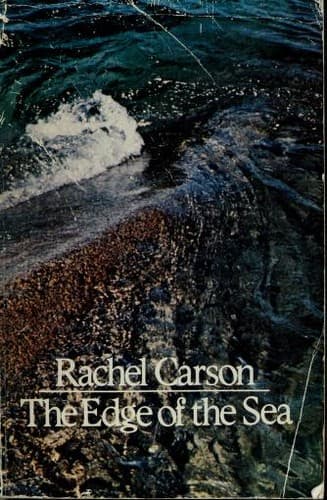
The Edge of the Sea
by Rachel Carson, Robert W. Hines
Carson's 1955 guide to the Atlantic shore turns a walk along the tide line into a close look at the life that survives there, and it still rewards a patient reader.
What It's About
The Edge of the Sea is Rachel Carson's 1955 guide to the strip of coast where land meets ocean along the Atlantic, from Maine down to the Florida Keys. Carson had already made her name with Under the Sea-Wind and The Sea Around Us, but here she turns from the open ocean to the tidal zone, the place a curious person can reach on foot in an afternoon. Robert W. Hines supplied the drawings, and they do much of the work of identification.
The approach is a set of linked portraits. Carson moves from sand flats to rocky headlands, salt marshes, and warmer reefs, and at each stop she asks what lives there, how it copes with being submerged and then exposed twice a day, and how its neighbors depend on it. Her prose is lyrical but never vague. She keeps returning to concrete details: timing with the tides, the physical pressures that shape a creature's body, and the small behaviors that reveal how an animal makes its living.
Reading it feels like walking a shoreline with a patient guide who notices everything. It is slow, sensory, and sometimes wistful about development and pollution, and it works best if you are willing to look up from the page and go outside. It is less a field manual than a way of learning to see.
Read this if you…
- want to understand tide pool and beach life without wading through a textbook
- are a beachcomber or new naturalist who wants a deeper sense of what you are looking at
- enjoy nature writing where precise science and lyrical description sit side by side
Skip it if you…
- need a current field guide with updated names, range maps, and photographs
- want a narrative with momentum or a plot to carry you through
Key Ideas
- 1
The shore is a zone of extremes
Every tide cycle exposes intertidal creatures to drying sun, shifting salinity, temperature swings, and crashing waves. Carson shows how these pressures sort animals and plants into bands along the shore, so that where an organism lives tells you a great deal about what it can tolerate.
- 2
Life at the edge depends on close relationships
Predators, competitors, scavengers, and filter feeders are tangled together in a small space. Carson treats the shore as a community rather than a collection of specimens, and she makes the reader see how one species' survival can hinge on another's.
- 3
Seeing well is a learned skill
The book is as much a lesson in observation as an account of facts. Carson encourages slow looking, comparing habitats, and asking why an animal is where it is. Hines's drawings reinforce this by making fine structural differences easy to notice.
- 4
Human pressure was already visible in 1955
Carson writes with concern about coastal development, collecting, and pollution, and her warnings give the book an elegiac tone. Readers should expect a mix of natural history and an early environmental argument, not a neutral catalogue.
Limitations
The book is now more than seventy years old, so its species names, classifications, and ecological explanations reflect the science of its day and some have been revised. Its geographic focus is the Atlantic coast, so readers on the Pacific or in other regions will find less that applies directly. Hines's drawings are charming but are not photographs, and some readers find the pacing leisurely, with passages that drift from specifics into general reflection. Its conservation warnings feel prescient, but they are written in a register that some modern readers may find more sentimental than analytical.
Questions Readers Ask
- Is The Edge of the Sea still useful as a field guide?
- As a identification tool, it is dated, because names and classifications have changed and the book has no photographs. Its real value now is conceptual: it teaches you how to read a shoreline and why its inhabitants are arranged the way they are. Pair it with a modern regional guide for identification.
- How does it compare to The Sea Around Us?
- The Sea Around Us covers the whole ocean, from its origins to its depths, with a broad, sweeping scope. The Edge of the Sea is narrower and more intimate, focused on the tidal zone and written for someone who wants to walk the shore and look closely. If you liked one, the other is a natural next step.
- Published
- 1955
- ISBN
- 9780451604149
- Difficulty
- beginner
- Category
- Science
Book details and cover from Google Books.
Ready to read The Edge of the Sea?
Get your copy on Amazon, or listen to it on Audible. We earn a commission if you buy through these links.