
We earn a commission if you buy through these links. Learn more
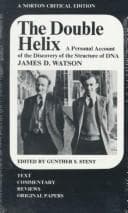
The double helix
by James D. Watson, Grover Gardner narrator
Guide by the Books of the Day editors · Updated · How we write our guides
Watson's firsthand, unfiltered account of the race to find DNA's structure reads like a lab thriller, and its candor about rivals and credit is still debated.
What It's About
The Double Helix is James Watson's personal account of how he and Francis Crick worked out the structure of DNA at Cambridge in the early 1950s. Published in 1968, it reads less like a textbook and more like a memoir of a scientific race, told by a young, impatient researcher who was not yet sure what he was doing.
Watson writes in a breezy, conversational voice, with frank judgments about colleagues, competitors and his own motives. The science arrives in pieces: model building, educated guesses, and the X-ray and chemical evidence that made the answer possible, all filtered through his memory and personality. That informality is the point, and it is also why the book has been argued over ever since.
Reading it is like eavesdropping on a lab across several years, with the pleasure of a puzzle being solved in real time. You will not get the methodical detail a textbook would give, and you should expect a one-sided view of events that involved many people.
Read this if you…
- Want an inside look at how a major scientific discovery actually unfolded, messy parts included
- Enjoy a personal, opinionated narrator and don't need a neutral, textbook voice
- Are curious about the ethics of credit and collaboration in research
Skip it if you…
- Want a clear, step-by-step explanation of the chemistry and biology of DNA
- Are put off by a narrator who is frank, self-interested and sometimes unkind about others
Key Ideas
- 1
Discovery built from models and guesses
Much of the book shows how the double helix emerged not from a single experiment but from physical models, trial fits and repeated corrections. Watson shows how often the team was wrong before it was right, which gives a realistic sense of how science moves forward through failed attempts rather than clean flashes of insight.
- 2
Collaboration and rivalry in a small lab
The partnership with Crick is the book's engine. Their personalities, their friction and their willingness to argue make the discovery feel social. Watson also shows how competition with other labs, especially in the United States, pushed the team to move faster and sometimes to take risks they would otherwise avoid.
- 3
Who gets credit for shared data
The book is best known for its treatment of the X-ray crystallography work of Rosalind Franklin and her colleague, which Watson saw without her full knowledge. Whether his account is fair is the central controversy, so the book is also a live case study in how credit, ethics and recognition operate in research.
- 4
Science as an ambitious, human pursuit
Beyond the facts, the book captures the mood of a postwar research culture: young men chasing a famous prize, hungry for recognition and anxious about being scooped. It treats science as something done by people with ego, doubt, luck and appetite, which is a useful counterweight to the tidy story found in most science writing.
Limitations
The book's biggest criticism is its portrayal of Rosalind Franklin, whose data was central to the breakthrough and who is described in ways many readers find dismissive and sexist. Watson's account is also self-serving by design, and it is not a balanced history of the work of many scientists. It stops around the discovery and its immediate aftermath, so it does not trace later developments in molecular biology, and its science is light on technical detail.
Questions Readers Ask
- Is The Double Helix still worth reading today?
- Yes, especially as a document of how DNA's structure was found and as a case study in scientific ethics. The science itself has been superseded by decades of research, so read it for the story and the people rather than for up-to-date facts. Pair it with more recent accounts for a fuller picture.
- What should I read alongside or after The Double Helix?
- For Franklin's side of the story, Brenda Maddox's biography Rosalind Franklin: The Dark Lady of DNA is a strong choice, and Anne Sayre's earlier book Rosalind Franklin and DNA is a classic. Reading one of these after Watson gives you a much more balanced view of the same events.
- Published
- 1968
- ISBN
- 9781501264009
- Difficulty
- beginner
- Category
- Science
Book details and cover from Google Books.
Ready to read The double helix?
Get your copy on Amazon, or listen to it on Audible. We earn a commission if you buy through these links.