
We earn a commission if you buy through these links. Learn more
The Dispossessed
A physicist from an anarchist moon crosses to his rival world, and Le Guin uses that trip to ask whether any society can stay free of becoming a cage.
What It's About
The Dispossessed (1974) is a science fiction novel built around two worlds that orbit each other. Anarres is a moon settled by people who broke away from Urras, a richer, more hierarchical planet, and it has tried to run without government, property, or formal authority. Shevek, a gifted physicist, is the book's center. The story moves between his life on Anarres and his time on Urras, and the switching lets Le Guin compare two ways of organizing people instead of simply cheering for one side.
Le Guin writes it as a slow, observant study rather than an action story. Much of the pleasure lies in texture: the labor assignments, the scarcity that shapes daily habits, and the way ideas about ownership sit in people's heads without anyone noticing. Scenes of Shevek's scientific work and his friction with institutions show how thinking is shaped by the community that funds and watches it.
Reading it feels more like sitting with a thoughtful argument than being carried by plot, and the prose rewards patience. Expect long stretches of conversation, politics, and introspection, with a few tense sequences. The book never hands you a tidy verdict. It keeps asking what freedom costs and who pays for it.
Read this if you…
- want a novel of ideas where the argument drives the story
- enjoy political fiction that doesn't flatter any side
- like quiet, observational worldbuilding more than action
Skip it if you…
- want fast plot and regular set-piece action
- find long passages of political debate tiring
Key Ideas
- 1
Anarchy as an unfinished, daily practice
Anarres is not a utopia that arrived fully formed. Its anarchism is something people maintain through cooperation, public argument, and constant vigilance against slipping back into domination. Le Guin shows how the ideal survives in everyday choices, and how fragile those choices can be when shortages and suspicion press in.
- 2
Property and the psychology of possession
The novel treats ownership as more than an economic arrangement. It shapes how people think about love, status, and their own worth. By showing characters who have never known private property alongside characters who cannot imagine life without it, Le Guin makes the reader feel how deeply the habit runs.
- 3
Two societies held up against each other
Rather than a simple hero's world and villain's world, the book sets two imperfect systems side by side. Each has real strengths and real cruelties, and each defines freedom in a different way. The comparison works as a mirror, prompting readers to examine the assumptions of the society they live in.
- 4
Science as a form of freedom and risk
Shevek's theoretical work on time and physics is more than background. It raises the question of whether ideas can cross political borders, and what happens to a thinker who refuses to let his work be owned or controlled by any authority. The scientific thread gives the political argument a concrete human stake.
Limitations
The prose is dense, and the alternating timelines can slow momentum, especially early on. Some readers find the Urras sections less vivid than the Anarres chapters, and the book's politics can feel more like a seminar than a story. Written in 1974, its gender roles and some character portrayals feel dated, and women's perspectives are present but less central than men's. It also offers no practical blueprint for building a free society, which some readers wanted and did not get.
Questions Readers Ask
- Do I need to read other Le Guin books first?
- No. The Dispossessed stands alone and does not depend on her other novels. If you have read her earlier work, you will recognize her interest in how cultures shape gender, belonging, and power, but none of it is required to follow this book.
- Is The Dispossessed still relevant today?
- Yes. Its questions about ownership, labor, and institutional power remain pointed, and many readers find it more relevant now than when it was published. Its 1970s assumptions about gender are the clearest sign of its age.
- How does it compare to Brave New World?
- Brave New World warns about a society that controls people through comfort and conditioning. The Dispossessed is more interested in a society that deliberately tries to be free, and in what that effort costs. Readers who liked Huxley's ideas often find Le Guin more hopeful and less bleak.
- Published
- 1974
- ISBN
- 9780575079038
- Difficulty
- intermediate
- Category
- Fiction
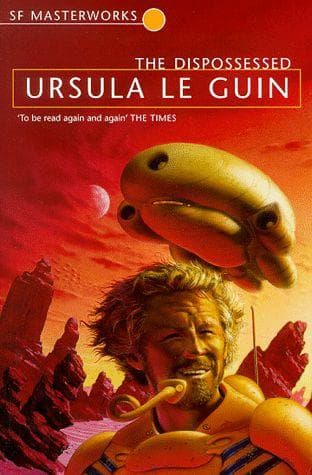
Book details and cover from Google Books.
Ready to read The Dispossessed?
Get your copy on Amazon, or listen to it on Audible. We earn a commission if you buy through these links.