
We earn a commission if you buy through these links. Learn more
The discoverers
Guide by the Books of the Day editors · Updated · How we write our guides
A sweeping, anecdote-rich history of how humans learned to map, measure, and understand the world, valuable for its argument that false certainty blocks discovery more than ignorance does.
What Creators Say About The discoverers
2 creators reviewed The discoverers on YouTube between 2020 and 2025, with 5.3K views between them. Their opinions are their own; we picked these reviews, we didn't write them.
What It's About
The Discoverers (1983) is Daniel J. Boorstin's attempt to tell the story of how people came to know the world, rather than a history of wars or rulers. It runs from early maps, calendars, and measurements in the ancient world through the scientific and geographic breakthroughs of the nineteenth century, covering voyages, astronomy, medicine, timekeeping, and the growth of institutions that stored and shared what people learned. Boorstin, who later served as Librarian of Congress, treats knowledge as something people had to build, often against inertia and error.
His approach is narrative and anecdotal rather than analytical. He moves between famous figures and forgotten ones, and between very distant periods, stitching them together with a steady interest in how one discovery made the next possible. The prose is brisk and often epigrammatic, and the book reads more like a long, opinionated tour than a textbook. You will meet familiar names, but also many people whose mistakes turned out to be useful.
Reading it is a pleasant way to spend time with a confident guide who enjoys surprising connections. It leaves you with a sense of how fragile and accidental much of our knowledge is. It is long, though, and the momentum sometimes slackens into lists of names and dates, so expect to read in stretches rather than in one sitting.
Read this if you…
- are curious about how scientific and geographic knowledge was actually built, including its false starts
- enjoy long, discursive histories built from vivid anecdotes rather than dense argument
- want a reminder that confident assumptions can block progress, in science or elsewhere
Skip it if you…
- want a rigorous, source-driven account of any single period or discovery
- need a modern, up-to-date treatment of the sciences, since much of the material is dated
Key Ideas
- 1
Confident error is a bigger barrier than ignorance
Boorstin argues that the main obstacle to discovery is not what people fail to know but what they are sure they already know. Settled belief, backed by authority and tradition, tends to hide the questions worth asking. Many of the book's episodes show a respected system resisting evidence that did not fit it, which makes the reader more alert to their own certainties.
- 2
Discovery often comes by accident or misreading
A recurring theme is that people frequently found something other than what they set out to find, or drew the wrong conclusions from the right observations. Explorers' errors reshaped maps, and mistaken assumptions sometimes opened new paths. Boorstin treats these detours as part of how knowledge actually advances, not as embarrassing exceptions to a neat story of progress.
- 3
Institutions are what let knowledge accumulate
Libraries, academies, museums, printing, and collections of instruments and specimens are central to the story. Boorstin suggests that individual genius matters less than whether a finding can be recorded, compared, and passed on. Without these structures, discoveries would be repeated, forgotten, or lost, which is why he pays close attention to the places where information was gathered and kept.
- 4
Knowledge is a chain, not a set of heroes
Although the book is full of named individuals, its underlying argument is that each advance depends on earlier work and on many people who never become famous. Boorstin keeps returning to the way one discovery enabled another across centuries. Readers who expect a simple list of great men will find a more connected picture, with individuals appearing as links in a long sequence.
Limitations
The book is written from a broadly Western perspective and centres European and American voyages, scholars, and institutions, so knowledge developed in other traditions gets far less space than it deserves. Its narrative of progress can read as triumphalist, and some of its scientific explanations have been superseded by later research. Boorstin's style is anecdotal, and specialist readers may find the sourcing thin and the connections more sweeping than they would like.
Questions Readers Ask
- Is The Discoverers still worth reading today?
- Yes, mainly for its big-picture argument and its storytelling. Some scientific details are outdated, and the Western-centred framing is noticeable today. Readers who treat it as an engaging overview rather than a final authority will get the most from it, and it works well as a starting point before reading more specialist histories.
- How does it compare to a more academic history of science?
- It is looser and more readable than most academic histories. Boorstin prioritises narrative momentum and memorable episodes over footnoted analysis of debates among historians. If you want a rigorous account of how particular theories were argued and accepted, a specialist history will serve you better. If you want to enjoy the sweep of the story, this book is a better choice.
- Published
- 1983
- ISBN
- 9789733302810
- Difficulty
- intermediate
- Category
- History
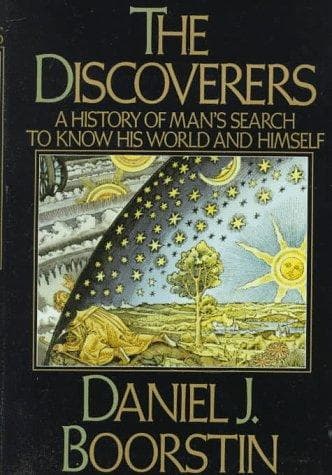
Book details and cover from Google Books.
Ready to read The discoverers?
Get your copy on Amazon, or listen to it on Audible. We earn a commission if you buy through these links.