
We earn a commission if you buy through these links. Learn more
The Diamond Age
A sprawling, funny novel about a smart interactive book that tries to raise a girl in a nanotech future, and a sharp look at class, education, and community.
What It's About
The Diamond Age is a novel set in a future where nanotechnology makes matter cheap to shape, and society has reorganized around affinity groups called phyles rather than nations. At its center is a girl named Nell, who comes into possession of an interactive book designed to teach a child to think and act for herself. Stephenson follows her alongside engineers, aristocrats, and people from the margins of the city, moving between a glossy, Victorian-flavored upper class and the rougher world below.
Stephenson's style is expansive and playful. He mixes precise technical detail with satire, shifts between viewpoints, and writes some passages in the manner of fairy tales or period fiction. The novel wears its ideas openly, and the pacing can feel uneven. Some sections move quickly, while others linger on theory or on long set pieces. The prose is confident and funny more often than not.
Reading it feels like opening a large, strange toy box. You get adventure, a coming-of-age story, and an extended argument about how people learn, what they owe one another, and whether technology can stand in for community. It rewards patience and a taste for digression more than it rewards speed.
Read this if you…
- enjoy big, idea-heavy science fiction that treats technology as a social force
- are curious about how education and childhood shape adult judgment
- like sprawling novels that mix humor, digression, and several tones at once
Skip it if you…
- want a tight plot and a fast, straightforward read
- prefer fiction grounded in realism without speculative premises
Key Ideas
- 1
Education as the shaping force of character
The central device is a book built to tutor a child through stories and personal challenges. The novel asks whether a designed teacher can produce a self-reliant person, and whether a child raised by a carefully engineered plan can still be truly her own. Stephenson treats learning as both liberating and quietly controlling.
- 2
Class and the performance of identity
The book pays close attention to how wealth and birth decide what people can become. It contrasts the elaborate manners of the privileged with the improvised survival of the poor, and shows how both groups perform roles. Much of the satire lands on the gap between what social codes promise and what they deliver.
- 3
Phyles and the question of belonging
Nations have given way to chosen communities that share culture, values, and language. Stephenson presents this as a source of warmth, loyalty, and rescue, but also as a route to tribalism and exclusion. The reader is invited to weigh what a group owes its members and what it can demand in return.
- 4
Abundance and the value of work
Matter compilers can produce nearly anything on demand, which upends old assumptions about scarcity, labor, and status. Stephenson is both fascinated and skeptical here, asking what happens to meaning and dignity when material needs are easily met.
- 5
A storytelling built from many voices
Stephenson alternates between characters, drops in fairy-tale interludes, and wanders into digressions that deepen the world. The structure is loose by design. Readers who enjoy seeing a big idea approached from several angles will find the form as interesting as the plot.
Limitations
Some readers find the middle stretches slow, and the lectures on theory can feel heavy-handed compared with the stronger character scenes. Certain portrayals of ethnicity and gender read as dated, and the novel's use of Chinese-influenced settings and characters has drawn criticism from readers who find them stereotyped at points. Its nanotechnology predictions also show their age, so the speculative details are less interesting than the social questions it raises.
Questions Readers Ask
- Is The Diamond Age really a science book?
- No. It is a novel, although it is often shelved under science. Its science is speculative, centered on nanotechnology, and the book is loose about mechanics. You don't need a technical background to enjoy it, though readers who like science fiction will find its ideas more rewarding.
- How does it compare to Snow Crash?
- Both books share Stephenson's satirical energy and big ideas. Snow Crash is faster, funnier, and more overtly cyberpunk. The Diamond Age is slower and more interested in education, class, and emotional stakes, so it suits readers who want depth over momentum.
- Is the novel still relevant?
- Its core questions about personalized learning, automation, and chosen communities remain current, even though its specific technology predictions are dated. Many readers find that the social observations hold up better than the gadgets.
- Published
- 1995
- ISBN
- 9780553898200
- Difficulty
- intermediate
- Category
- Science
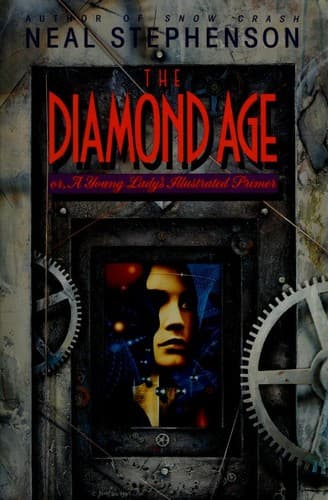
Book details and cover from Google Books.
Ready to read The Diamond Age?
Get your copy on Amazon, or listen to it on Audible. We earn a commission if you buy through these links.