
We earn a commission if you buy through these links. Learn more
The Dharma Bums
by Jack Kerouac
A loose, joyful Beat novel about friendship, Buddhism and mountain wandering, worth reading for its voice and its portrait of a restless generation searching for meaning.
What It's About
The Dharma Bums is a 1958 novel by Jack Kerouac, narrated by Ray Smith, a young writer in California who falls in with Japhy Ryder, a poet and mountain climber who is deep in Buddhist study. Ray is a close stand-in for Kerouac himself, and Japhy is modeled on the poet Gary Snyder. The story moves between the San Francisco poetry scene, climbing trips, and long hitchhiking journeys, with Ray trying to work out what a serious spiritual life might look like for someone who would rather drink wine and write than sit still.
Stylistically, the book is pure Kerouac: spontaneous, run-on sentences, lists, digressions, and a conversational voice that feels like someone talking at you across a campfire. The plot is episodic. Scenes are held together by the friendship and by Ray's restlessness rather than by a tight arc. The book cares more about mood, sensation and the pull between ambition and ease than about conflict or suspense.
Reading it is an immersive and sometimes frustrating experience. Long stretches of nature description and philosophical enthusiasm can drift, and the ideas arrive as excitement more than argument. Still, the warmth, humor and sense of youthful possibility are hard to shake, and the book rewards patience with moments of real clarity about hope and loneliness.
Read this if you…
- want a loose, spontaneous novel about friendship and the open road
- are curious about the Beat writers and the 1950s San Francisco poetry scene
- enjoy nature writing and quiet reflection more than a conventional plot
Skip it if you…
- need a tight plot with clear stakes and a satisfying structure
- find run-on prose exhausting or are uneasy with romanticized travel, drinking and drifting
Key Ideas
- 1
Friendship as a spiritual practice
The bond between Ray and Japhy is the engine of the book. Japhy is part teacher, part foil, and his ideal of the simple, cheerful wanderer gives Ray a model to test against his own doubts. The novel suggests that spiritual growth often happens through companionship and shared outdoor work rather than through solitary study.
- 2
Buddhism as a lived, informal practice
Zen and Buddhist ideas run through the book, but they are filtered through a restless young American rather than presented as doctrine. Practice here means meditation, simplicity, kindness toward others and a willingness to let go of possessions. Kerouac is more interested in how these ideas feel in daily life than in their philosophical details.
- 3
Wilderness as a place of clarity
Mountains, trails and high solitude act as a counterweight to city life and the pressure of getting ahead. Nature in the book is not scenery to admire but a space where the narrator can think without distraction. Readers who enjoy outdoor writing will find some of the novel's most lasting passages here.
- 4
Restlessness and the search for a home
Much of the book is about movement: hitchhiking, changing cities, and never quite settling. Kerouac asks whether freedom leads anywhere or simply postpones the question of how to live. The tension between the appeal of the open road and the longing for stability gives the episodic story its emotional undertow.
Limitations
The novel is often criticized for its treatment of women, who appear mainly as background or as objects of the narrator's desire, and some passages about other cultures now read as romanticized or shallow. Its take on Buddhism is enthusiastic and selective rather than scholarly, so readers looking for an accurate introduction to the tradition should look elsewhere. The episodic structure and repetitive, lyrical style can also make the middle section feel slow, and the book's sense of freedom sometimes depends on others doing the unglamorous work of supporting it.
Questions Readers Ask
- Is The Dharma Bums a sequel to On the Road?
- Not exactly. It shares Kerouac's loose, spontaneous voice and some of the same restless energy, but it has a different narrator, different companions and a different focus. On the Road is mostly about frantic travel and a dazzling, unstable friend. The Dharma Bums is more reflective, and its interest in nature and spirituality makes it feel calmer, though still restless.
- Does The Dharma Bums still hold up today?
- Partly. The book's enthusiasm for nature, simplicity and searching for meaning still lands with many readers. Its attitudes toward women and its romanticized views of Asian religion feel dated, so it works best as a historical document of its moment that still has something to say about longing and friendship.
- Published
- 1950
- ISBN
- 9780670019939
- Difficulty
- beginner
- Category
- Fiction
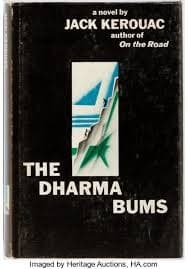
Book details and cover from Google Books.
Ready to read The Dharma Bums?
Get your copy on Amazon, or listen to it on Audible. We earn a commission if you buy through these links.