
We earn a commission if you buy through these links. Learn more
The devil's arithmetic
by Jane Yolen
Guide by the Books of the Day editors · Updated · How we write our guides
A bored American teenager is pulled into a Polish village in 1942, and Jane Yolen's short, direct novel makes the Holocaust feel personal to readers who have only met it in textbooks.
What Creators Say About The devil's arithmetic
2 creators reviewed The devil's arithmetic on YouTube between 2009 and 2026, with 3.1K views between them. Their opinions are their own; we picked these reviews, we didn't write them.
What It's About
The Devil's Arithmetic follows Hannah Stern, a restless American girl who would rather be anywhere than at her family's Passover seder. She resents the rituals and the endless talk of the dead. When she opens the door for the prophet Elijah, she is pulled back to 1942 Poland, into a village where she becomes Chaya, a young woman among relatives she has only heard about in family stories.
Yolen writes in a plain, clear style aimed at younger readers, with brisk chapters and little ornament. The horror builds gradually: the roundups, the crowded transports, and the slow loss of ordinary life. Much of the book's force comes from the gap between what Hannah knows from history and what Chaya can see. Hannah carries the outcome in her head, while the people around her are still living their days without knowing it.
Reading it feels like a focused, emotional lesson more than a deep historical study. It is short enough to finish in a sitting or two, and it stays with you because it asks what memory owes the dead, and what it means to treat a family story as your own rather than as something to sit through once a year.
Read this if you…
- want a short, emotionally direct introduction to the Holocaust for a younger reader or a teen
- are interested in time-travel stories that use a historical setting to ask serious questions
- want to think about how families pass down memory and what it asks of the next generation
Skip it if you…
- want a detailed historical account of the Holocaust, with documented context and perspectives from many sources
- prefer complex prose or ambiguous characters and find sparse, direct storytelling thin
Key Ideas
- 1
Remembering as a duty, not a ritual
The Passover seder is built around the instruction to remember, and Hannah starts out treating that instruction as a boring formality. The novel slowly turns remembering into something active and painful, a responsibility that falls on the living to keep the dead from being reduced to statistics.
- 2
Time travel that makes history personal
The time-slip device lets a modern reader stand inside events they usually study from a distance. Hannah's knowledge of what is coming gives the early scenes an ominous quality, and it turns the question of what she can do with that knowledge into the book's central tension.
- 3
Names and identity under persecution
Hannah's new name, Chaya, is more than a costume. The book shows how identity is stripped away in the camps through names, labels, and routines, and how holding on to who you are becomes an act of resistance in itself.
- 4
Ordinary people facing impossible choices
The village is made up of families, neighbors, and arguments, not heroes. Yolen shows people making small decisions under terrible pressure, and the moral weight of those decisions is what makes the story land more than any single dramatic moment.
Limitations
Some adult readers find the novel's style simple to the point of thinness, and the characters are drawn more as types than as fully developed people. The time-travel frame is a convenient vehicle that can feel contrived, and the book's portrayal of Jewish village life and of the camps is necessarily compressed. Because it is written for young readers, it avoids some of the darkest detail, which some will see as a strength and others as a limit. Its emphasis on American Jewish identity also reflects the concerns of its era more than those of the present day.
Questions Readers Ask
- Is The Devil's Arithmetic suitable for children?
- It is generally recommended for upper elementary and middle-school readers, roughly ages 10 and up, and it is widely taught in schools. The violence is present but not graphic. Parents may want to read it alongside their child, since the subject is heavy and the ending asks hard questions that are worth discussing.
- How does it compare to a more detailed Holocaust memoir?
- It is much shorter and more focused on emotion than a memoir such as Night by Elie Wiesel. Yolen trades historical depth and firsthand testimony for accessibility and a fictional frame. Read it first if you want an entry point, then move to a memoir or history for the full weight of the events.
- Published
- 1988
- ISBN
- 9780142404379
- Difficulty
- beginner
- Category
- Fiction
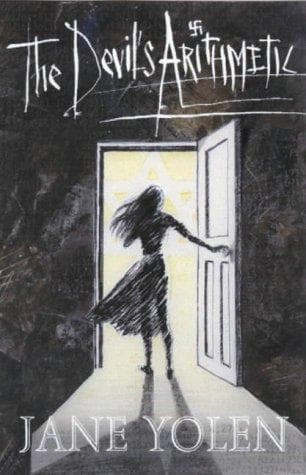
Book details and cover from Google Books.
Ready to read The devil's arithmetic?
Get your copy on Amazon, or listen to it on Audible. We earn a commission if you buy through these links.