
We earn a commission if you buy through these links. Learn more
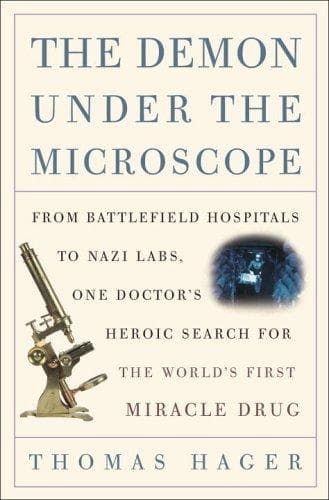
The Demon Under the Microscope
by Thomas Hager
Guide by the Books of the Day editors · Updated · How we write our guides
A gripping science history of how the first antibacterial drug was found in a German dye company's lab, and what that search cost the people who made it.
What Creators Say About The Demon Under the Microscope
2 creators reviewed The Demon Under the Microscope on YouTube between 2022 and 2023, with 336 views between them. Their opinions are their own; we picked these reviews, we didn't write them.
What It's About
The Demon Under the Microscope follows the search for the first effective systemic antibacterial drug, centered on Gerhard Domagk, a German pathologist working in the research labs of the chemical company Bayer in the 1930s. Hager frames the story around a long, unglamorous hunt for a chemical that could kill bacteria inside the body without killing the patient, a problem that had frustrated doctors since the age of surgical antiseptics.
Hager writes as an experienced science journalist. He moves between laboratory benches, wartime hospitals where infection killed more soldiers than bullets did, and the politics of Nazi Germany. He balances the chemistry with human stakes, so the technical material stays readable without being reduced to a string of triumphs. The pace is steady and narrative rather than dense.
Reading it feels like being walked through an archive by a historian who wants you to see how a discovery actually happens: through false leads, rival labs, shared credit, and luck. It is less a biography than a case study in how medicine gets made, and the ethical shadows over the story give it real weight.
Read this if you…
- are curious about how modern drugs were first discovered, not just what they do
- enjoy narrative history that mixes lab work with wartime and political context
- want a readable account of early antibiotics without heavy chemistry
Skip it if you…
- want a detailed technical guide to how sulfa drugs or antibiotics work at the molecular level
- are looking for a full biography of Gerhard Domagk and his personal life
Key Ideas
- 1
The magic bullet dream
Hager traces the idea, associated with Paul Ehrlich, that a chemical might be built to seek out a microbe and destroy it while leaving the body alone. It was a bold goal that shaped decades of research, and the book shows how much of the hope rested on trial and error rather than theory.
- 2
Why ordinary infections were so deadly
Before antibiotics, a scratch, a childbirth, or a battlefield wound could turn fatal within days. Hager makes this threat concrete, which helps explain why a working drug was treated as a near-miraculous breakthrough and why so many researchers were willing to chase it.
- 3
Discovery by systematic screening
A central theme is that the breakthrough came from testing large numbers of compounds on infected animals and noting what worked, not from a clean theory. The book makes the slow, repetitive labor of screening vivid and shows how often it failed before it succeeded.
- 4
Science under a dictatorship
The story is shadowed by Nazi Germany. Hager shows how the regime's pressure affected who could accept honors and how research could be shaped by politics, which gives the scientific narrative an uneasy moral edge that many popular science books avoid.
- 5
Who gets credit for a drug
Hager examines how the finding was later clarified by researchers elsewhere, and how a single discovery can be claimed by a company, a lab, a team, and a nation at once. It is a useful lens on how scientific credit gets assigned and sometimes contested.
Limitations
Some readers find the book's storytelling more polished than rigorous, with dramatic framing that can get ahead of the evidence in places. Its focus is narrow: it centers one drug family and its discovery, so it does not survey the wider history of antibiotics such as penicillin in depth. Because it was written in the mid-2000s, later research on sulfonamide mechanisms and resistance is not reflected. The chemistry is explained for general readers, which some specialists will find too simple.
Questions Readers Ask
- Is The Demon Under the Microscope hard to read?
- Not especially. Hager explains the chemistry in plain terms and keeps the focus on people, labs, and events. A general adult reader with some interest in science or history should follow it easily. The occasional technical passage may slow you down, but you rarely need a background in chemistry to keep the thread.
- How does it compare to other books on the history of medicine?
- It is closer to a focused narrative case study than a broad survey like a general history of antibiotics. If you want one discovery told with suspense, character, and political context, it works well. If you want the full sweep of medicine across centuries, you will likely want a wider book alongside it.
- Published
- 2006
- ISBN
- 9781400082148
- Difficulty
- intermediate
- Category
- History
Book details and cover from Google Books.
Ready to read The Demon Under the Microscope?
Get your copy on Amazon, or listen to it on Audible. We earn a commission if you buy through these links.