
We earn a commission if you buy through these links. Learn more
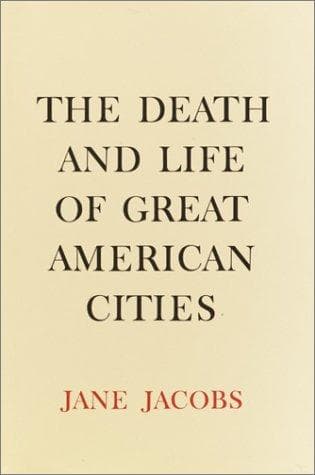
The Death and Life of Great American Cities
by Jane Jacobs
Guide by the Books of the Day editors · Updated · How we write our guides
A sharp, field-tested argument that changed how we think about streets, density, and neighborhood safety, and still challenges planners and anyone who assumes order is the same as good urban life.
What Creators Say About The Death and Life of Great American Cities
2 creators reviewed The Death and Life of Great American Cities on YouTube in 2020, with 15.8K views between them. Their opinions are their own; we picked these reviews, we didn't write them.
What It's About
Published in 1961, The Death and Life of Great American Cities is a sustained attack on the city planning orthodoxy of its day. That orthodoxy treated dense, older neighborhoods as blight to be cleared and replaced with towers in parks, wide roads, and strictly separated zones. Jacobs argues from close observation of streets rather than abstract theory. She watched how sidewalks, stoops, shops, and corner life actually worked in places like Greenwich Village and Boston's North End, and she asks why some areas thrive while others, planned for order, feel empty and unsafe.
The approach mixes reporting, polemic, and field notes. Jacobs writes in a direct, conversational voice, often reacting to specific planners and projects, and she builds her case through many small examples rather than one formal model. The passages on the everyday life of the sidewalk give way to more analytical sections on what generates lively districts. The reading experience is brisk and combative. You will often feel like you are arguing with her as much as learning from her.
Reading it now means encountering a book that reshaped how people talk about streets, zoning, and density, written in an era when expert authority was being questioned in new ways. Its pages reward attention to the ordinary, and they make a persuasive case for looking closely at a neighborhood before judging it.
Read this if you…
- want a classic argument about why some cities succeed and others fail
- are interested in urban planning, housing policy, or neighborhood activism
- enjoy opinionated nonfiction that builds its case from close observation of everyday life
Skip it if you…
- want a modern account with current data on housing, climate, or transit
- prefer a neutral history of urban planning rather than a passionate polemic
Key Ideas
- 1
Eyes on the street as natural safety
Jacobs argues that streets are safe when many people informally watch them. Busy, mixed-use sidewalks with shopkeepers, residents, and passersby create constant, low-key surveillance without any formal policing. Empty, single-purpose areas, by contrast, feel dangerous precisely because no one is around to notice what happens there.
- 2
Four conditions for urban diversity
She identifies a small set of conditions that together produce lively districts: mixing primary uses so people are out at different times, short blocks that encourage walking and choice, buildings of varied age and condition, and enough concentration of people. Her point is that these conditions work together, and that removing one tends to weaken the others.
- 3
Cities as self-organizing complexity
Jacobs contends that planners often treat cities as simple machines that can be redesigned from above. She argues instead that urban neighborhoods are complex systems that organize themselves through countless small interactions, such as shop owners knowing regulars or neighbors keeping an eye on children. Overriding those processes tends to break them.
- 4
The damage of clearance and superblocks
The book is a critique of slum clearance and large-scale redevelopment, which she sees as destroying working social networks and local economies. Superblocks and expressways cut neighborhoods apart and replaced active streets with blank, inactive spaces. Her arguments were rooted in specific fights over real projects, which gives the critique its urgency.
- 5
Informal public life and trust
Much of the book describes how trust in cities grows from ordinary contact: greetings, casual errands, and shared use of the sidewalk. Jacobs suggests that public life is not a luxury added to a city but the mechanism that makes it function, and that planners who ignore it misunderstand what gives streets their value.
Limitations
The examples are mid-century American cities, and some of her observations reflect the neighborhoods and assumptions of their time. Critics note that she underplays the role of race, class, and federal housing policy in shaping which places were cleared and which survived. Her romantic view of crowded, working-class streets can overlook the costs of living in them, and later readers have connected her ideas to gentrification debates she could not have foreseen. Many claims rest on personal observation rather than systematic study, so they are better read as strong hypotheses than settled findings.
Questions Readers Ask
- Is The Death and Life of Great American Cities still relevant?
- Yes. Its core ideas about mixed-use streets, walkability, and the dangers of single-purpose zoning still shape debates about housing and urban design. The specific examples and some of the social assumptions are dated, so readers should treat it as a foundational argument rather than a current guide.
- How does it compare to Robert Caro's The Power Broker?
- Caro's book is a massive biography of Robert Moses, the planner whose projects Jacobs opposed, and it covers his career in exhaustive detail. Jacobs offers a shorter, more theoretical case about what cities need. Readers who want the political story should read Caro, while those interested in the ideas behind urban design will find Jacobs more direct.
- Published
- 1961
- ISBN
- 9783764363567
- Difficulty
- intermediate
- Category
- History
Book details and cover from Google Books.
Ready to read The Death and Life of Great American Cities?
Get your copy on Amazon, or listen to it on Audible. We earn a commission if you buy through these links.