
We earn a commission if you buy through these links. Learn more
The Daughter of Time
Josephine Tey's 1951 mystery turns a bedridden detective loose on whether Richard III killed the princes, and it's a sharp lesson in how history gets written.
What It's About
The Daughter of Time is a 1951 mystery by Josephine Tey. Inspector Alan Grant, stuck in a hospital bed with a broken leg and bored out of his mind, turns his attention to a cold case that has nothing to do with street crime: whether Richard III murdered his nephews, the two young princes in the Tower of London. Friends bring him portrait reproductions, and he begins to doubt the story everyone learned at school.
Most of the book is conversation and deduction rather than action. Grant works through the question much as he would a live case, weighing motives, testing contradictions, and questioning witnesses who are long dead. An American researcher, Brent Carradine, visits libraries to dig up original sources. Tey's approach is witty and openly argumentative, and Grant is a dry, sardonic investigator who enjoys puncturing received opinion. Reading it feels like sitting in on a lively seminar where one side has a clear brief.
The experience is less a whodunit than an essay on how history gets written. You won't find a conventional crime plot, a body count, or much suspense in the usual sense. What you get is the pleasure of watching evidence reexamined, and a strong sense that the official version was shaped by people with reasons to shape it.
Read this if you…
- enjoy mysteries that are mostly talk, reasoning, and argument
- are curious about why Richard III's reputation changed so dramatically
- like witty, opinionated narrators with a dry edge
Skip it if you…
- want fast plotting, suspense, or a crime with a culprit in the present
- need a balanced historical account and will be frustrated by a one-sided case
Key Ideas
- 1
Received history can be deeply wrong
The popular picture of Richard III was largely formed by Tudor-era chroniclers and later dramatists writing under a new dynasty. Grant treats their accounts as sources with motives rather than neutral records, and the book asks readers to notice how long a confident story can survive without solid proof behind it.
- 2
Go back to the original documents
Grant's central habit is distrusting summaries and secondhand retellings. He keeps asking what the earliest surviving evidence actually says, and who wrote it, when, and why. The book makes a convincing case that careful reading of primary material can overturn a reputation that textbooks have repeated for centuries.
- 3
Reputation can work as evidence
Tey shows how a person's image gets built and then starts to stand in for proof. The book asks who benefited from the story about the princes and how a verdict can be reached by repetition rather than by testing. It is a useful lesson for anyone who has accepted a famous judgment without checking it.
- 4
Ordinary detective method, applied to the past
Motive, opportunity, inconsistency, and character are the same tools Grant would use on a modern case. Applying them to a five-hundred-year-old mystery gives the book its distinctive charm, and it shows how much of police reasoning is really about asking the right question in the right order.
Limitations
The book is openly partisan. Tey builds a persuasive defense of Richard III but tilts the evidence to suit her case, and later historians have pushed back on several of her readings. The fate of the princes remains unproven, so the novel is best read as a provocative argument rather than settled history. Its 1951 attitudes also show in some of its assumptions about character and class. Readers who expect a traditional detective pace may find the long stretches of reflection slow.
Questions Readers Ask
- Do I need to know anything about Richard III before reading?
- No. Tey explains the standard story as she goes, and Grant's reasoning makes the stakes clear. Some familiarity with the Wars of the Roses helps you enjoy the arguments more, but the book is designed to be read cold. A general sense of who the princes were is enough to follow everything.
- Is it still worth reading for modern readers?
- Yes, especially if you care about how history is written and who gets to write it. The historical debate has moved on since 1951, so treat the book as a model of skeptical reading rather than a final verdict on Richard III. Its prose and wit still hold up well.
- How does it compare to Tey's other Alan Grant novels?
- Her other Grant novels are more conventionally plotted, with crimes, suspects, and reveals. This one is the most essay-like of the series, because the question is historical and the investigation happens largely in a hospital room. If you want the detective fiction, pick a different Grant novel first.
- Published
- 1951
- ISBN
- 9780671821227
- Difficulty
- intermediate
- Category
- Fiction
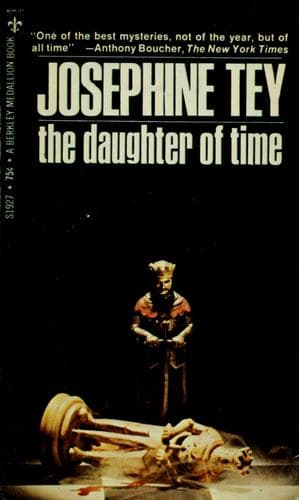
Book details and cover from Google Books.
Ready to read The Daughter of Time?
Get your copy on Amazon, or listen to it on Audible. We earn a commission if you buy through these links.