
We earn a commission if you buy through these links. Learn more
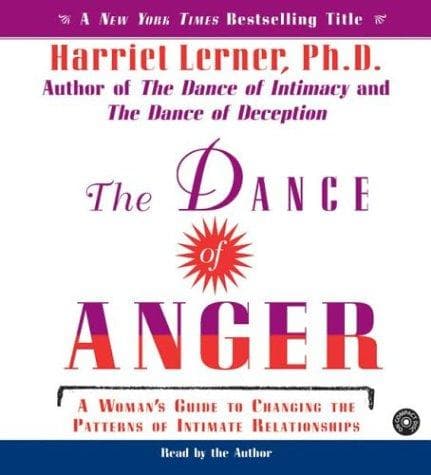
The Dance of Anger
Harriet Lerner's classic reframes anger as information about broken patterns in relationships, and shows readers how to change their own part in the dance.
What It's About
The Dance of Anger, first published in 1985, is a self-help book by a psychologist written mainly for women who feel stuck in repeated fights with partners, mothers, daughters, bosses, or friends. Lerner's central move is to treat anger neither as a flaw to eliminate nor as a force to unleash, but as a signal that something in a relationship needs attention, often a boundary, a value, or an expectation that has been crossed.
What sets the book apart is its focus on patterns. Lerner describes how two people's reactions lock into a sequence, each move prompting the next, so that the cycle keeps running even when both people want it to stop. She asks readers to examine their own contribution rather than trying to change the other person. The writing is conversational and practical, built around many illustrative examples and concrete suggestions for speaking more clearly without attacking or retreating.
Reading it feels less like absorbing theory than like being coached through a set of uncomfortable experiments. It is short enough to finish in a couple of sittings, but the ideas take much longer to apply, because they ask you to notice old habits as they happen. Keep in mind that the book reflects its era, and its language about gender and family roles is noticeably dated.
Read this if you…
- want practical language for handling recurring arguments with a partner, parent, or close friend
- are a woman who was taught to suppress anger or to express it only as blame
- prefer a short, concrete self-help book over dense theory or therapy-style memoir
Skip it if you…
- are looking for guidance on abusive or violent relationships, which the book does not treat in depth
- want current research on emotion, neuroscience, or gender, since the book predates much of that work
Key Ideas
- 1
Anger as a signal, not a verdict
Lerner argues that anger tells you something is wrong, but not necessarily what or who is responsible. The useful question is what the feeling is pointing toward, such as an unmet need or a line that has been crossed. Treating anger as information rather than proof of someone else's badness opens up more constructive options than either swallowing it or venting it at full volume.
- 2
Repetitive interaction patterns
Much of the book is about the recurring sequences that couples, parents, and siblings fall into. One person pursues while the other withdraws, or one over-functions while the other stays passive, and each behavior reinforces the other. Seeing the pattern as a shared dance, rather than a series of separate blowups, makes it easier to see where a single change might interrupt the loop.
- 3
Changing your own part
Lerner's most practical advice is that you cannot control how someone else responds, but you can alter your side of the exchange. That might mean saying less, saying something different, or stopping a familiar role such as rescuer or critic. The emphasis on your own move keeps the focus on what you can actually do rather than on winning an argument about who started it.
- 4
Clear, direct speech about what you want
The book encourages readers to state their position plainly and specifically, using statements about themselves rather than accusations about the other person. The aim is not to be harsh or to score points, but to stop hinting, over-explaining, or waiting for others to guess. Lerner presents clarity as a way of staying connected while still being honest about your own views.
- 5
Staying connected while being yourself
Drawing on family systems thinking, Lerner describes the balance between closeness and separateness as a lifelong task. A person who cannot tolerate disagreement will keep giving in or fighting, while a person who cannot tolerate closeness will keep cutting off. The goal she describes is to remain emotionally present with others while keeping a clear sense of your own thoughts and choices.
Limitations
The book is most aimed at heterosexual couples, mothers and daughters, and women in traditional family roles, and its assumptions about gender feel dated to many readers. Its emphasis on changing your own part can seem to place the burden on the person who is already less powerful in a relationship. It does not address abuse, coercion, or structural pressures in depth, and it does not offer the evidence base or clinical detail that newer work on emotion regulation provides.
Questions Readers Ask
- Who is The Dance of Anger best suited for?
- It suits readers who notice they keep having the same arguments and want a clear framework for understanding their part in them. It is especially useful for women who were raised to keep the peace at any cost. Readers in situations involving abuse or safety concerns should seek specialized support rather than relying on this book alone.
- Is The Dance of Anger still relevant today?
- Its core idea, that anger carries information and that relationships run on repeated patterns, still holds up well. The examples, gender assumptions, and some terminology reflect the 1980s, so readers should treat them as period detail. Many people pair it with newer work on emotion and communication for a fuller picture.
- Published
- 1985
- ISBN
- 9780060538835
- Difficulty
- beginner
- Category
- Psychology
Book details and cover from Google Books.
Ready to read The Dance of Anger?
Get your copy on Amazon, or listen to it on Audible. We earn a commission if you buy through these links.