
We earn a commission if you buy through these links. Learn more
The Dain curse
A tangled, atmospheric San Francisco mystery where Hammett's spare prose turns a family's supposed curse into a sharp study of greed, fear and lies.
What It's About
The Dain Curse is a 1929 novel by Dashiell Hammett, the writer who helped define the hard-boiled detective story. It follows a San Francisco private investigator pulled into the affairs of a wealthy family whose members speak of a long-running misfortune they only half believe in. Each inquiry opens onto new people with reasons to lie, and the case grows more tangled as it goes.
Hammett's style is the first thing a reader notices. His sentences are short and unadorned, dialogue carries much of the weight, and the investigator reports what he sees and hears without much interior commentary. He lets atmosphere do the rest: fog, damp houses, and a sense of decay hanging over the family. The book reaches further into Gothic territory than his tighter short fiction, and it is more willing to linger over history and gossip than to keep the plot moving at a sprint.
Reading it is less like following a clean puzzle than like sitting in on a series of interviews. The pleasure lies in the texture of the talk, the small betrayals, and the way violence arrives abruptly and without ceremony. Expect a story that cares more about who people are and what they want than about fair-play clues, and expect the explanations at the end to do a good deal of work.
Read this if you…
- enjoy hard-boiled crime with a Gothic, uneasy atmosphere
- want to see Hammett's style before his tighter later novels
- don't mind a tangled plot in exchange for vivid talk and mood
Skip it if you…
- need a clear, fair-play puzzle you can solve before the detective does
- prefer characters with rich inner lives and emotional arcs
Key Ideas
- 1
A curse that works like a social force
The family's belief in a curse matters less as supernatural fact than as something people use: to excuse behavior, hide guilt, or explain away bad luck. Hammett lets the reader decide how much of the doom is real and how much is manufactured. That question sits under nearly every scene and shapes how characters treat one another.
- 2
Spare prose that trusts the reader
Hammett describes actions, speech, and surfaces, and leaves feelings for the reader to infer. He uses few adjectives, quick exchanges, and no speeches about motive. The result feels cool and objective, and it rewards close attention to what characters say and what they carefully avoid saying.
- 3
A detective who observes rather than judges
The investigator is paid to find things out, not to moralize. He takes money from people he suspects and keeps his own counsel. Readers used to heroic sleuths may find him unsettling, since his loyalty seems mostly to the job and to getting the facts straight rather than to any clear sense of right and wrong.
- 4
Gothic atmosphere in a modern city
Hammett places crumbling mansions, gossip about old money, and whispered family history inside a realistic San Francisco of the late 1920s. Mixing crime fiction with Gothic horror gives the book an uneasy, dreamlike drift that sets it apart from his sharper, more streetwise novels.
Limitations
Critics often note that the plot is more convoluted than satisfying, and that some explanations arrive quickly after long stretches of misdirection. The Gothic material can feel melodramatic to readers used to Hammett's later, more controlled novels. Women are sketched with the conventions of the period, and the racial and class attitudes of 1920s popular fiction appear in places. The book also lacks the moral grip of The Maltese Falcon or Red Harvest, and it does not explore its characters' inner lives in depth.
Questions Readers Ask
- Should I read The Dain Curse before The Maltese Falcon?
- Not necessarily. The Maltese Falcon is the tighter, more finished novel and the better entry point to Hammett. The Dain Curse rewards readers who already know his style and want to see how he handled longer, messier material. Starting here can feel slow and scattered, so most newcomers do better with The Maltese Falcon or Red Harvest first.
- Is The Dain Curse still worth reading today?
- Yes, mainly for the prose and the mood. The plot is uneven and some attitudes of its era feel dated, but Hammett's economy with language still reads as modern. The book also shows how crime fiction was moving beyond the classic drawing-room puzzle, which makes it most rewarding for readers interested in the history of the genre.
- How does it compare to Red Harvest?
- Red Harvest is more savage and more clearly plotted, with its fictional city of Personville consumed by open gang war. The Dain Curse is quieter, more domestic, and more inclined toward Gothic mood. Both share Hammett's flat, clipped style, but Red Harvest has the stronger sense of momentum.
- Published
- 1929
- ISBN
- 9780899661155
- Difficulty
- intermediate
- Category
- Fiction
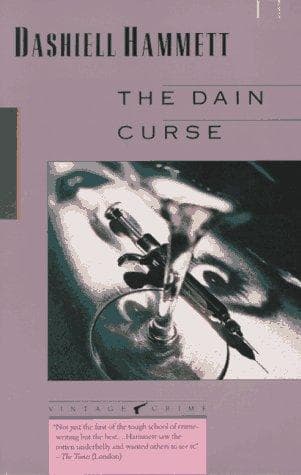
Book details and cover from Google Books.
Ready to read The Dain curse?
Get your copy on Amazon, or listen to it on Audible. We earn a commission if you buy through these links.