
We earn a commission if you buy through these links. Learn more
The Crusades
Guide by the Books of the Day editors · Updated · How we write our guides
A single, readable narrative of the Crusades from 1095 to 1291 that gives Muslim rulers like Saladin as much weight as the Christian armies.
What Creators Say About The Crusades
2 creators reviewed The Crusades on YouTube between 2013 and 2025, with 4.7K views between them. Their opinions are their own; we picked these reviews, we didn't write them.
What It's About
The Crusades: The War for the Holy Land is a narrative history of the holy wars fought over Jerusalem and the Levant from 1095 to the fall of Acre in 1291, told as one continuous story rather than a set of separate expeditions. Asbridge, a medieval historian, moves between the crusaders' camps and the courts of the Muslim rulers who opposed them, so the Latin West is no longer the only point of view. The result treats the conflict as a long, messy struggle rather than a single clash of civilizations.
The style is brisk and vivid, built around battles, sieges, personal rivalries and the logistics that often decided outcomes. Asbridge pays close attention to shifting alliances: Christian states frequently fought each other, Muslim powers were often divided, and the Byzantine Empire was an uneasy partner whose interests did not always match those of the Latin armies. He also gives figures such as Saladin and the crusading kings enough personality to feel like people rather than symbols.
Reading it feels like being guided through a long campaign by a historian who knows the ground well. It works less as a reference book than as a sustained argument for seeing the period as contingent and contested, and the pace rarely lets up for long.
Read this if you…
- want a single-volume narrative that covers the whole period from start to finish
- want the Muslim side of the story given real weight alongside the Christian one
- are curious how medieval politics and warfare actually worked on the ground
Skip it if you…
- want a short, light introduction, since this is a long and detailed book
- are mainly interested in the religious ideas, spiritual motives or devotional side of the crusading movement
Key Ideas
- 1
The crusades as one long conflict
Asbridge treats the period from the First Crusade to the loss of Acre as a single, continuous war with long pauses and renewals, rather than a neat sequence of numbered crusades. This framing helps explain why later expeditions made sense to their participants and why the Holy Land was never settled for good.
- 2
Muslim leaders restored to the story
Rulers such as Zengi, Nur al-Din and Saladin are placed at the center of events rather than treated as obstacles. The book shows how the crusader states became one player among several in a region where Muslim powers gradually consolidated control, which changes how the outcome looks.
- 3
Politics inside the Frankish states
Much of the book's drama comes from rivalries among Frankish lords, disputed royal successions, the role of the military orders, and tensions with the Byzantines. These internal divisions matter as much as external enemies in explaining why the Christian presence in the east was so fragile.
- 4
Military reality over romance
Campaigns are judged by supply lines, castle building, the cost of sieges and the difficulty of holding territory far from home. Asbridge uses these practical constraints to explain failures and reversals, which gives the book a grounded tone that avoids the glamour of chivalric legend.
Limitations
The book is dense with names, places and dates, and readers new to the period may need a map and a timeline alongside it. Its focus is political and military, so religious thought, popular piety and the everyday experience of pilgrims and settlers get less room. Some critics argue that the narrative leans on chronicle sources that were themselves partisan, and that telling one overarching story can flatten regional variation. Specialist scholarship has also moved on in areas such as crusade ideology and the wider Mediterranean world, so it is best read as a strong narrative rather than the final word.
Questions Readers Ask
- Is this a good first book on the Crusades?
- It can be, provided you are prepared for a dense, fact-heavy narrative. It covers the whole period in one volume and explains the main campaigns clearly. Readers who want a gentler start might begin with a shorter overview, then come back to Asbridge for the full picture and the political detail.
- How does it compare to Jonathan Riley-Smith's The Crusades: A History?
- Riley-Smith's book is more concerned with the ideas, religious motives and origins of the movement, while Asbridge is more focused on events, military decisions and political rivalry. Asbridge gives Muslim leaders more prominence. Many readers find the two complementary rather than competing.
- Published
- 2010
- ISBN
- 9780060787295
- Difficulty
- intermediate
- Category
- History
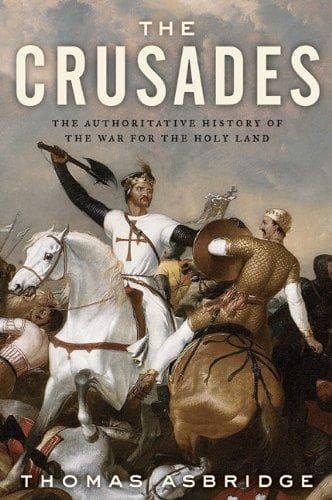
Book details and cover from Google Books.
Ready to read The Crusades?
Get your copy on Amazon, or listen to it on Audible. We earn a commission if you buy through these links.