
We earn a commission if you buy through these links. Learn more
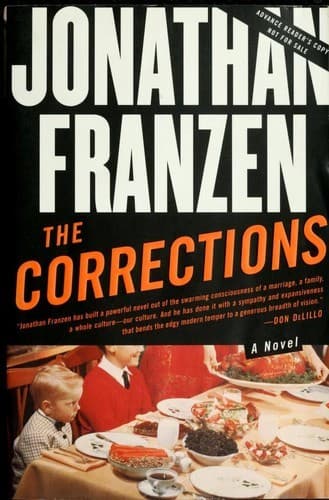
The Corrections
by Jonathan Franzen, Àlex Gombau
Guide by the Books of the Day editors · Updated · How we write our guides
A funny, painful portrait of an American Midwestern family whose aging father is losing his mind, with sharp satire of money, markets, and the gap between who we are and who we hoped to be.
What Creators Say About The Corrections
2 creators reviewed The Corrections on YouTube between 2010 and 2017, with 81.5K views between them. Their opinions are their own; we picked these reviews, we didn't write them.
What It's About
The Corrections (2001) follows the Lambert family of St. Jude, a fictional Midwestern city, in the years just before the new millennium. Alfred, a retired railroad engineer, is sliding into Parkinson's and dementia, and his wife Enid is determined to gather their three adult children for one last Christmas at the family home. Each child is in a different kind of trouble. Gary, the eldest, is a financial executive whose marriage and sense of himself are coming apart. Chip, the middle son, has lost his academic post and is drifting toward bad schemes. Denise, the youngest, is a chef whose love life is complicated.
Franzen moves between these family members, giving each a long close-third-person section with its own anxieties and voice. The narration is funny and precise about consumer culture, corporate life, and the ways people fail each other while meaning well. Broad social satire sits alongside quiet scenes of marriage, parenthood, and illness.
Reading it is absorbing rather than fast. The sentences are dense, the sections run long, and the book asks you to stay with characters who are often hard to like. Readers who settle into its rhythm tend to find it bracing and tender in equal measure.
Read this if you…
- enjoy big, character-driven family novels with sharp social satire
- want a comic but unsparing look at aging parents and grown siblings
- are comfortable with long, dense sentences and a slow build
Skip it if you…
- want a fast plot or a tidy, hopeful resolution
- find unlikable characters or extended satire of work and money hard to sit through
Key Ideas
- 1
Love and damage inside one family
The Lamberts care for one another deeply and still wound each other constantly. Franzen treats resentment, rivalry, and disappointment as part of family love rather than as its opposite, which gives the book much of its emotional force. Each sibling's version of the same childhood differs, and the gaps between those versions drive much of the tension.
- 2
Watching a parent's mind give way
Alfred's decline is the quiet center of the novel. Franzen shows how illness changes not only the sick person but the family's routines, arguments, and guilt. The book is less interested in medical detail than in what it feels like to be responsible for someone whose personality is slipping away, and to be unsure what you owe them.
- 3
Satire of money, markets, and self-improvement
Much of the comedy comes from the characters' attempts to succeed in a world of finance, consumer goods, and therapeutic self-help. Gary's professional life and Chip's ambitions abroad show how people chase status and reinvention while missing what they actually need. The satire is pointed but grounded in specific, recognizable behavior.
- 4
Shifting perspectives as the book's method
Moving among the family's point-of-view sections lets Franzen show the same events from several angles, so the reader sees more than any character does. The structure rewards attention: a detail in one section often reframes a scene in another. It is the feature most readers remember, and the one that makes the book demanding.
Limitations
Critics have argued that the satire can turn heavy-handed, and that some characters are drawn more as types than as people. The book's world is mostly white, affluent, and centered on the concerns of middle-class men, so readers looking for a wider range of experience may find it narrow. Its late-1990s setting also shows in its technology and financial references, which now read as period detail rather than current life.
Questions Readers Ask
- Is The Corrections still worth reading today?
- Yes. Its core subjects, including aging parents, adult siblings who never quite grew apart, and money anxiety, still feel true. Some references to technology, markets, and the pre-2001 economy now read as period detail, but the family drama and the sharp observation of ordinary behavior hold up well.
- How does The Corrections compare to Franzen's Freedom?
- The Corrections is tighter, focusing on one family and one pressing question: whether they can gather for one last Christmas. Freedom, published in 2010, is broader in scope and more openly political. If you liked the Lambert family but want a larger canvas, Freedom is the natural next step, but many readers prefer the more compact earlier book.
- Do I need to read anything before this novel?
- No. The Corrections stands alone and does not depend on earlier books. The one thing that helps is patience with the shifting point of view, since each section sets up its own world before the story moves on.
- Published
- 2001
- ISBN
- 9788498384147
- Difficulty
- intermediate
- Category
- Fiction
Book details and cover from Google Books.
Ready to read The Corrections?
Get your copy on Amazon, or listen to it on Audible. We earn a commission if you buy through these links.