
We earn a commission if you buy through these links. Learn more
The Conscious Mind
Chalmers gives the clearest statement of why explaining consciousness is hard, then argues the answer may require rethinking what physical reality is made of.
What It's About
The Conscious Mind is a long, argumentative work of analytic philosophy that asks a deceptively simple question: why does physical activity in the brain feel like anything from the inside at all? Chalmers begins by sorting the questions people call 'the problem of consciousness' into two groups. Most are tractable puzzles about how the brain does things like discriminating colors or reporting on its own states. One, which he calls the hard problem, is different in kind, because even a complete functional account would seem to leave out experience itself.
Much of the book is spent clearing ground. Chalmers examines reductive theories that try to dissolve the problem, weighs the thought experiments philosophers use to test whether experience could be missing from a physically identical being, and considers why such arguments are so hard to settle. He then proposes his own position, a form of naturalistic dualism in which experience is treated as a basic feature of the world alongside physical properties, and sketches principles that might link the two through laws of psychophysical correspondence. Chalmers also discusses information as a possible bridge between physics and mind.
The experience is demanding rather than comforting. Expect dense prose, careful distinctions, and objections raised and answered over many pages, with a steady willingness to follow arguments where they lead. Chalmers writes clearly for a philosophical reader and is generous to opponents, but he does not simplify the material for a general audience, so this is a book to read slowly and with notes nearby.
Read this if you…
- are curious about why brain science has not yet explained experience and want a rigorous map of the debate
- enjoy philosophy of mind and can follow long chains of argument without a guide
- are a student or researcher who wants the canonical statement of the hard problem before engaging its critics
Skip it if you…
- want a readable introduction to neuroscience or a summary of recent empirical findings on consciousness
- find thought experiments about zombies and colour-knowledge cases tedious or unconvincing and want answers rather than arguments
Key Ideas
- 1
Easy problems versus the hard problem
Chalmers separates problems that can be solved by explaining mechanisms, such as how the brain integrates information or controls behavior, from the question of why any of this is accompanied by subjective experience. The distinction organizes the whole book. Its value is that it shows exactly where a scientific account stops and a further puzzle begins, even if you end up doubting that the line is as sharp as he claims.
- 2
Conceivability and the explanatory gap
Chalmers argues that we can coherently imagine a being physically identical to us yet lacking experience, and that this suggests experience is not logically entailed by physical facts. He uses this to frame the explanatory gap between physical description and felt experience. Critics respond that conceivability is a poor guide to possibility, and how persuasive the argument feels depends on how much weight you give that move.
- 3
A third option: naturalistic dualism
Rather than adopt either reductive materialism or classic Cartesian dualism, Chalmers proposes that consciousness is a fundamental feature of reality, linked to physical processes by systematic laws. He calls this naturalistic dualism because it keeps the world law-governed and continuous with science while adding experience as an irreducible element. Many readers find this position either bold or unsatisfying, and the book makes a serious case for it.
- 4
Information as a double-aspect bridge
One of the more distinctive threads is the suggestion that information, understood as structured patterns of difference, may be a basic element of reality with both physical and experiential aspects. Chalmers treats this double-aspect view as a candidate for the fundamental theory he thinks is missing. The idea is sketched rather than fully worked out, which is worth knowing before you expect a finished solution.
Limitations
Chalmers's positive proposal is deliberately tentative, and many readers find the naturalistic dualism and double-aspect ideas underdetermined. The zombie and conceivability arguments remain contested, and many philosophers think the hard problem rests on a confusion. Published in 1996, the book predates much of the later empirical work on global workspace and integrated information theories and does not reflect those developments. Its scope is philosophical, so it offers little on neuroscientific method.
Questions Readers Ask
- Is The Conscious Mind still worth reading given advances in neuroscience?
- Yes, mainly for its conceptual framework. Chalmers's distinction between explaining functions and explaining experience remains the reference point for most debates, even among people who reject his conclusions. You will not get current empirical results, so pair it with newer reviews of consciousness science if you want the latest data.
- How does it compare with Dennett's Consciousness Explained?
- Dennett's book attempts to dissolve the hard problem through a functionalist account of the mind, while Chalmers argues the problem is real and resists that dissolution. Dennett is more polemical and conversational in tone; Chalmers is more systematic and careful. Reading both gives you the clearest picture of the central disagreement in the field.
- Do I need a philosophy background to read it?
- Not formally, but you need patience with careful argument and comfort with abstract distinctions. Chalmers defines his terms as he goes and the opening chapters are accessible, but the middle sections assume familiarity with debates about functionalism and physicalism. An introductory philosophy of mind text will help.
- Published
- 1996
- ISBN
- 9780195105537
- Difficulty
- advanced
- Category
- Science
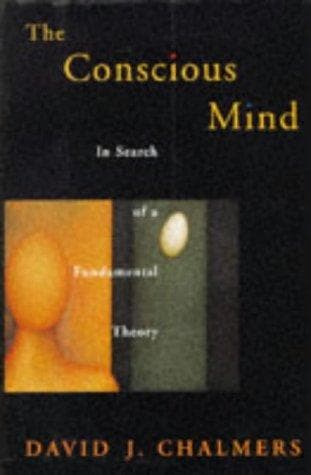
Book details and cover from Google Books.
Ready to read The Conscious Mind?
Get your copy on Amazon, or listen to it on Audible. We earn a commission if you buy through these links.