
We earn a commission if you buy through these links. Learn more
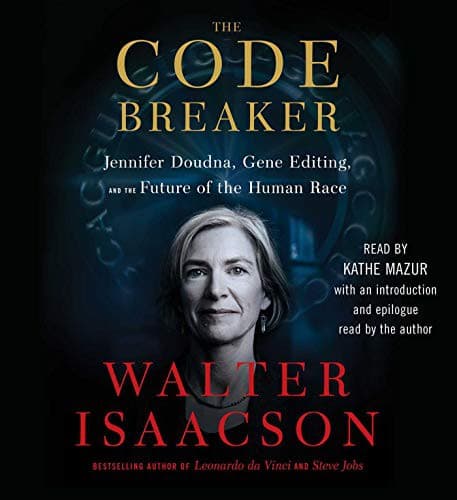
The Code Breaker
by Walter Isaacson, Kathe Mazur
Guide by the Books of the Day editors · Updated · How we write our guides
A clear, gripping account of how the CRISPR gene-editing tool was discovered, the scientific race behind it, and the ethical questions it raised, told through the scientist at its center.
What It's About
The Code Breaker is nonfiction, not a novel, despite the Fiction label on this listing. Walter Isaacson, who has also written biographies of Steve Jobs, Albert Einstein and Leonardo da Vinci, follows Jennifer Doudna, a biochemist who helped turn a bacterial immune mechanism into CRISPR-Cas9, a tool that can edit DNA with unprecedented precision.
The book braids three threads together: the basic science of how bacteria defend themselves against viruses, the competition between academic labs over discovery credit and patents, and the ethical arguments that followed once editing human embryos became technically possible. Isaacson explains the molecular ideas in plain language, though some biochemistry will still require patience. The tone is reportorial and brisk, built on extensive reporting rather than lyrical description.
Reading it feels like watching a scientific race unfold, with personalities and rivalries driving the narrative as much as experiments do. Doudna is the central figure, but the book also gives real attention to her collaborator Emmanuelle Charpentier, with whom she shared the 2020 Nobel Prize in Chemistry, and to the wider community of researchers whose work shaped the field.
Read this if you…
- are curious about how CRISPR was discovered and why it matters
- enjoy narrative science writing that mixes biography with ethical debate
- want a sense of how scientific priority and patent fights shape research
Skip it if you…
- want a detailed, technical textbook explanation of molecular biology
- are looking for fiction, since this is a nonfiction biography despite the listing
Key Ideas
- 1
Gene editing as a discovery story
The book treats CRISPR not as a sudden invention but as the outcome of years of curiosity-driven research into how bacteria recognize and cut invading viral DNA. It shows how work on an obscure microbial defense system became a general-purpose tool for changing genetic code, which is a useful lesson about where breakthroughs actually come from.
- 2
Science as a competitive, personal enterprise
Isaacson pays close attention to rivalries over priority, publication timing and patent rights. The story makes clear that research funding, university politics and personal relationships shape which discoveries get recognized, and it asks readers to weigh scientific merit against the messy human process of crediting it.
- 3
The ethics of editing human heredity
A large part of the book deals with what happens when a powerful editing tool reaches the point of altering human embryos. It covers the scientists' own unease, the calls for restraint, and the case of an unauthorized experiment that shocked the field, pressing readers to consider who should decide where such lines are drawn.
- 4
A biography built around one scientist
Because the book follows Doudna's path, it turns abstract molecular biology into a story about motivation, doubt and responsibility. Readers who want the science delivered through a human arc will find the framing effective, even when the lab details become dense.
Limitations
The book is a snapshot of a fast-moving field, and CRISPR research has advanced quickly since its publication, so some applications and clinical developments will feel dated. Its portrayal of the patent dispute has been criticized as leaning toward the Doudna and Charpentier side, and some readers find the rival perspective underrepresented. The science is simplified for a general audience, so specialists may want deeper technical sources alongside it.
Questions Readers Ask
- Is The Code Breaker fiction or nonfiction?
- It is nonfiction. Walter Isaacson wrote it as a biography and scientific history about Jennifer Doudna and the development of CRISPR gene editing. The Fiction category on this listing appears to be an error, so readers looking for a novel should check the edition before buying.
- Do I need a science background to enjoy it?
- No, but it helps to be comfortable with basic biology concepts like DNA and proteins. Isaacson explains the key ideas in accessible terms, and the personal story carries the book even when the lab details get technical.
- Published
- 2001
- ISBN
- 9781665910668
- Difficulty
- intermediate
- Category
- Fiction
Book details and cover from Google Books.
Ready to read The Code Breaker?
Get your copy on Amazon, or listen to it on Audible. We earn a commission if you buy through these links.