
We earn a commission if you buy through these links. Learn more
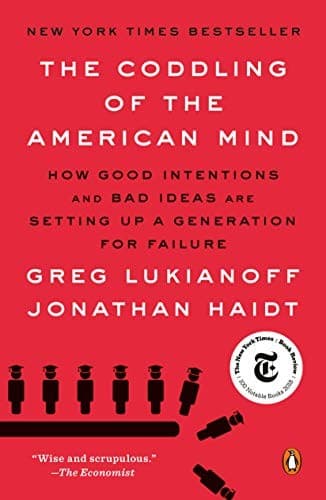
The Coddling of the American Mind
by Greg Lukianoff, Jonathan Haidt
A sharp, contested case that campus culture and childhood overprotection may have made many young Americans more anxious, with practical tools for thinking through it.
What It's About
The Coddling of the American Mind, published in 2018, is an argument by Greg Lukianoff, who leads a free-speech advocacy group, and Jonathan Haidt, a social psychologist known for his work on moral psychology. They begin with campus life: disinvitations, trigger warnings, and a sense that students were increasingly treated as fragile. From there they widen the lens to ask why young Americans seemed more anxious and depressed in the early 2010s than the generation before them.
Their method blends case studies, psychology, and policy argument. Lukianoff draws on his work with students who came to him with free-speech and disciplinary problems, and on the cognitive behavioral therapy tradition, which gives the book a practical vocabulary for spotting distorted thinking. Haidt supplies the broader frame: how less unsupervised play, more adult supervision, and constant online connection may have trained young people to see danger everywhere. The tone is a brisk, opinionated essay rather than a dense academic monograph, written to persuade readers across the political spectrum.
Reading it feels like being handed a diagnosis and a set of tools at once. Some chapters are more convincing than others, and the authors are candid that parts of their case rest on surveys, anecdotes, and correlations. It works best as a lens and a conversation starter rather than a final verdict on any campus or generation.
Read this if you…
- want to understand the debate over campus speech and student mental health from a critical but sympathetic angle
- are a parent or teacher wondering how much to shield young people from discomfort
- like a short, argumentative book that gives you concrete mental tools you can use right away
Skip it if you…
- want a rigorous, heavily footnoted academic study with full statistical detail
- already have a firm position on campus politics and want only confirmation or only rebuttal
Key Ideas
- 1
Safetyism: when protection undermines growth
The authors argue that a growing cultural priority on shielding people from emotional and physical harm can leave them less able to cope with ordinary difficulty. Their point is not that safety is unimportant, but that treating every discomfort as an emergency may prevent the everyday exposure that builds resilience and confidence.
- 2
Three bad ideas that shape thinking
The book builds its argument around three ideas it calls Great Untruths: that what does not kill you makes you weaker, that you should always trust your feelings, and that life is a struggle between good people and bad people. Each is examined as a belief that can feel reasonable while quietly making anxiety and conflict worse.
- 3
Cognitive distortions as a practical toolkit
Drawing on cognitive behavioral therapy, Lukianoff offers recognizable patterns such as catastrophizing, emotional reasoning, and mind reading. The value here is practical: readers get language for noticing these habits in themselves and others, and for questioning a thought before acting on it.
- 4
Play, parenting, and phones as possible causes
Haidt presents a case that declining free play, heavier adult supervision, and the arrival of smartphones and social media may have contributed to rising youth distress. The evidence here is largely correlational and widely debated, so the argument is best read as a hypothesis backed by suggestive data.
Limitations
Critics argue the book leans heavily on anecdotes, surveys, and correlations, and that it overstates the scale of campus censorship and the role of culture while underweighting economic pressure, family breakdown, and other explanations for rising distress. Some left-leaning readers see it as dismissing structural injustice and treating activism itself as the problem. The campus examples have also aged, and the authors' later focus on phones and adolescence, developed in Haidt's follow-up work, is itself debated.
Questions Readers Ask
- Is The Coddling of the American Mind still relevant?
- Yes, largely because the questions it raises about youth anxiety, phones, and campus speech remain active. Specific incidents it describes are dated, so the framework matters more than the examples. Haidt later expanded on the phone-focused side of the argument in The Anxious Generation, which readers interested in that thread may want to read next.
- Does the book take a political side?
- The authors present it as a concern shared across the political spectrum, and they criticize pressures from both left and right. Many readers still experience it as aligned with one side, and critics on each side have pushed back on particular claims. Reading it alongside a response from the other perspective will give you a fuller picture.
- Published
- 2018
- ISBN
- 9780241308356
- Difficulty
- intermediate
- Category
- Science
Book details and cover from Google Books.
Ready to read The Coddling of the American Mind?
Get your copy on Amazon, or listen to it on Audible. We earn a commission if you buy through these links.