
We earn a commission if you buy through these links. Learn more
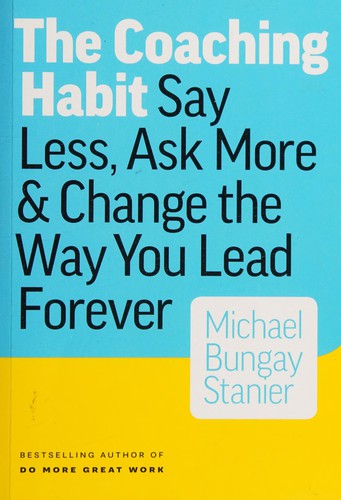
The coaching habit
A short, practical guide to breaking the reflex of giving advice, replacing it with a small set of open questions you can use in everyday conversations with the people you lead.
What It's About
The Coaching Habit is a short, practical book by Michael Bungay Stanier, a coach and writer, aimed mainly at managers who want to stop solving every problem for their teams. Its central claim is that most leaders reach for advice within seconds of hearing a problem. That reflex may feel helpful, but it keeps people dependent, leaves their own thinking underused, and wears the leader out. The book treats advice-giving as a habit that can be noticed and changed.
The approach is deliberately lean. Stanier builds the book around seven questions, each with a short explanation of when it helps and why, plus guidance on catching your own urge to tell people what to do. He writes in a brisk, conversational voice and leans on workplace examples, so the material feels grounded rather than academic. The structure is meant to be used, not just read.
Reading it feels less like studying a theory and more like being handed a toolkit and a gentle push to try it. It can be finished in a single sitting, but the real value comes from testing a question in your next one-to-one, noticing what happens, and trying again. Expect a book that rewards practice more than reflection, and that works best if you are willing to hold back your own answers for a while.
Read this if you…
- manage people and want to spend less time solving their problems for them
- find yourself jumping in with answers in meetings and want a practical way to change that
- prefer short, actionable books you can start using the same week
Skip it if you…
- want a deep grounding in coaching psychology or formal coaching methods
- are looking for guidance on handling serious performance problems or conflict
Key Ideas
- 1
Advice-giving is a reflex to notice
Stanier argues that the urge to jump in with a solution is automatic for many leaders. The first step he proposes is simply becoming aware of that urge in the moment, before acting on it. Once you see it clearly, you have a chance to choose a different response rather than repeating the same pattern with every team member.
- 2
Good questions do more than advice
The book's core shift is from telling to asking. Open questions invite people to examine their own situation, which tends to produce ownership and clearer thinking. Stanier presents questions not as a technique for manipulating people but as a way of respecting their capacity to find answers that will actually stick.
- 3
A small set of questions for every conversation
Rather than offering a long framework, the book gives a compact set of questions that can cover a conversation from its opening to its close. The idea is that you do not need to memorise a model. A few reliable prompts, used consistently, can carry you through most one-to-one and team discussions without much preparation.
- 4
Focus on the real challenge and what to drop
Two of the questions push beyond the surface issue. One helps a person identify what is really getting in the way, and another asks what they would need to stop doing in order to say yes to a new commitment. These prompts turn a loose discussion into a clearer decision about priorities, which is often the most useful outcome of a coaching conversation.
Limitations
Some readers find the book repetitive, since its core message is simple and the chapters revisit it in different settings. It is also written mainly for managers working with teams, so people coaching outside a workplace, or working with clients rather than staff, may find the examples less relevant. The book does not go deep into the evidence behind coaching techniques, and it says little about situations where a leader must be directive, such as safety issues or urgent deadlines. The 'say less' message can be taken too far if it is applied rigidly.
Questions Readers Ask
- Who is The Coaching Habit best suited for?
- It suits managers, team leads, and anyone who regularly finds themselves giving advice when someone else could work out the answer. Because it is short and practical, it is also a good first book for people new to coaching-style conversations. Experienced coaches may find the core ideas familiar but still useful as a reminder of simple prompts to use in the moment.
- How does it compare to Coaching for Performance by John Whitmore?
- Coaching for Performance is more structured and theoretical, built around a formal model and a deeper treatment of coaching principles. The Coaching Habit is lighter and more immediately usable, focused on changing your default behaviour in everyday conversations. If you want a framework and background, read Whitmore. If you want to start changing your habits this week, Stanier's book is the quicker route.
- Is the advice still relevant today?
- Yes, the core idea that leaders benefit from asking before telling remains widely shared in management practice, and the book's advice is not tied to any particular technology or market. Some examples are dated, and the book's tone is breezy, but the questions themselves are simple enough to apply in most workplaces today.
- Published
- 2016
- ISBN
- 9780978440749
- Difficulty
- beginner
- Category
- Leadership
Book details and cover from Google Books.
Ready to read The coaching habit?
Get your copy on Amazon, or listen to it on Audible. We earn a commission if you buy through these links.