
We earn a commission if you buy through these links. Learn more
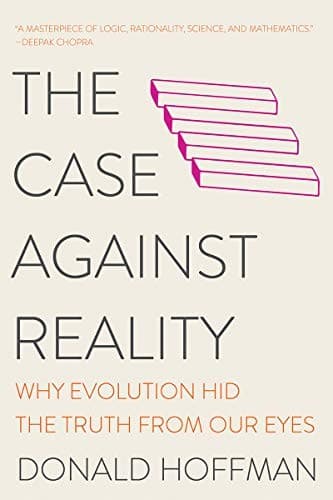
The Case Against Reality
Hoffman makes a provocative case that evolution shaped our senses to keep us alive, not to show us the world as it is, and it will change how you think about perception.
What It's About
The Case Against Reality is a popular science book by Donald Hoffman, a cognitive scientist who studies perception. His central claim is that our senses evolved to help us survive and reproduce, not to reveal objective truth. He compares our experience of space, objects, and color to desktop icons: useful for getting things done, but not faithful pictures of the circuitry underneath. From there he builds toward a more radical position about the nature of consciousness and reality.
The book is part argument, part tour. Hoffman draws on evolutionary game theory, computer simulations, research on visual illusions, and older philosophy, including Kant. He is more interested in making a case than in surveying the field, so the chapters feel like a sustained advocacy piece rather than a neutral overview. He is often playful and occasionally combative toward mainstream views he thinks are too comfortable.
Reading it is an energetic, slightly unsettling experience. Hoffman uses vivid analogies and thought experiments to make abstract ideas feel concrete, and he writes with obvious confidence. The pleasure lies in watching a familiar intuition, that what we see is what is there, come apart under pressure. You will likely finish it with more questions than settled answers, which is part of the point.
Read this if you…
- Enjoy provocative science writing that challenges everyday assumptions about seeing and knowing
- Are curious how evolution shapes perception and how that connects to philosophy of mind
- Like being pushed to question whether your senses give you an accurate picture of the world
Skip it if you…
- Want a neutral survey of the science of perception with balanced coverage of competing views
- Get frustrated by a confident author who argues one side hard and rarely dwells on objections
Key Ideas
- 1
Perception as a user interface, not a window
Hoffman's interface theory proposes that what we experience is a simplified display built to guide behavior. A desktop icon is useful because it hides the messy electronics behind it, not because it resembles them. He argues that space, objects, and colors work the same way, so our everyday sense of how the world looks is a practical summary rather than an accurate copy.
- 2
Why evolution favors fitness over truth
The core argument is that natural selection rewards organisms that act effectively, not those that perceive accurately. Hoffman supports this with simulations and a mathematical result he develops with collaborators, suggesting that a truthful perceiver can be outcompeted by one with a cheaper, more useful representation. The idea challenges the common assumption that evolved senses must be roughly reliable.
- 3
Illusions as evidence of practical design
Hoffman treats visual illusions not as glitches but as clues. If perception were a faithful reflection of reality, its failures would be random. Instead he argues they reflect shortcuts that work well enough for survival, which is a useful lens for rethinking how much weight we give to our own sensations.
- 4
Consciousness as the foundation of reality
The most ambitious part of the book moves from perception to metaphysics. Hoffman proposes a view he calls conscious realism, in which consciousness is fundamental and physical objects are how conscious agents appear to one another. This section is where the book shifts from empirical argument toward philosophical speculation, and readers will weigh it differently.
Limitations
Critics argue that the simulation and game-theory results rest on simplified models, so they may not capture the complexity of real organisms. Some philosophers and neuroscientists think Hoffman dismisses realism too quickly and that the step from an interface metaphor to a conscious-realist metaphysics is not earned. The tone can read as overconfident, and the later chapters go well beyond what the empirical evidence directly supports. Readers should treat the bold conclusions as a hypothesis to test, not a settled result.
Questions Readers Ask
- Is The Case Against Reality hard to read?
- No. It is written for general readers and avoids heavy mathematics in the main text. Some passages on evolutionary modeling and philosophy require concentration, but the analogies are clear and the chapters are fairly brisk. A reader with some interest in psychology or philosophy should follow it without difficulty.
- Is the book still relevant to research on perception?
- Yes, it remains a useful entry point to debates about whether perception is veridical. Its specific claims are contested, and researchers continue to disagree about how far evolution favors accuracy. Read it as a provocative argument that sharpened these questions, and pair it with more mainstream perception science for balance.
- Published
- 2019
- ISBN
- 9780393541489
- Difficulty
- intermediate
Book details and cover from Google Books.
Ready to read The Case Against Reality?
Get your copy on Amazon, or listen to it on Audible. We earn a commission if you buy through these links.