
We earn a commission if you buy through these links. Learn more
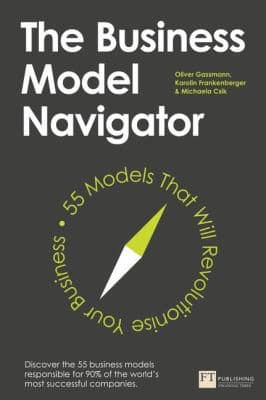
The business model navigator
A practical catalogue of 55 proven business model patterns that helps managers spot new ways to earn money, whether they run a startup or an established firm.
What It's About
The Business Model Navigator is a practical toolkit for managers who want to rethink how their company makes money, not just what it sells. Its central move is to treat business models as patterns that can be recognized, borrowed, and recombined. The authors, Oliver Gassmann, Karolin Frankenberger and Michaela Csik, catalogue 55 models that have worked across industries, from subscription and freemium pricing to platforms and razor-and-blade arrangements, and explain how each one creates and captures value.
The approach is pattern-based rather than theoretical. Each model gets a short description, examples of companies that used it, and guidance on when it fits and what it demands. The book also explains how to use the catalogue in an innovation process: examining your own situation, scanning patterns from other sectors, and combining them into new options to test. The emphasis is on generating and evaluating ideas, so the reading experience is closer to working through a reference with exercises than following one continuous argument.
Expect a tone that is businesslike and hands-on, with many examples and short sections built for quick consultation. It rewards readers who are working on a real strategy question and will feel thin to someone wanting deep analysis of why certain models succeed or fail. The company examples reflect the period in which the book was written, so readers should treat them as illustrations of a pattern rather than as current facts about those businesses.
Read this if you…
- are a manager or founder rethinking how your organization earns revenue
- want a concrete menu of pricing and business model options to brainstorm from
- prefer structured tools and examples over long theoretical arguments
Skip it if you…
- want a deep academic analysis of why some business models outperform others
- are looking for a fast read with a single clear thesis you can summarize in a sentence
Key Ideas
- 1
Business models as recombinable patterns
The book's core idea is that most new business models are variations on a limited set of recurring patterns. Seeing a model as a pattern makes it easier to borrow a proven approach from another industry instead of starting from scratch, and to combine two or more patterns into something a competitor has not tried.
- 2
Looking beyond your own industry
Many of the most useful ideas come from sectors far removed from the reader's own. A pricing or customer-relationship approach that is routine in one market may be rare in another. The authors encourage managers to deliberately search outside their field, since familiar industries tend to share the same blind spots about how revenue could be earned.
- 3
Revenue logic as a set of deliberate choices
A business model is treated as a set of choices about who the customer is, what is offered, how value gets delivered, and how the company is paid. Changing one choice often forces changes elsewhere, so the book pushes readers to examine the whole arrangement rather than tweaking a price or a channel in isolation.
- 4
Innovation as generating then testing options
The book frames business model change as a process: first generate several candidate models, then assess them against your resources, customers, and risks before committing. This structure keeps the framework useful for teams that need a sequence of steps, not only a list of ideas to admire.
Limitations
The book is strongest as a catalogue and weakest as an explanation. It describes what models exist and when they tend to fit, but gives less rigorous evidence about how often each one succeeds. Many examples come from a specific period, and some companies it praises have since changed direction or faced difficulties. Readers may also find the process steps more generic than the pattern list, and it says little about execution, organizational resistance, or the financing needed to test a new model.
Questions Readers Ask
- Is The Business Model Navigator still relevant today?
- Yes, for the most part. The core patterns, such as subscription, freemium, platforms, and pay-per-use, remain widely used. The company examples are dated, so treat them as illustrations and look up current cases to see how each pattern is working now.
- How does it compare to Business Model Generation?
- Business Model Generation focuses on a single visual canvas for describing and sketching one business model. The Business Model Navigator is broader in a different way: it offers a library of 55 patterns to borrow from. Many managers find the two work well together, with the canvas for mapping and the catalogue for generating ideas.
- Published
- 2014
- ISBN
- 9781292065816
- Difficulty
- beginner
- Category
- Business
Book details and cover from Google Books.
Ready to read The business model navigator?
Get your copy on Amazon, or listen to it on Audible. We earn a commission if you buy through these links.