
We earn a commission if you buy through these links. Learn more
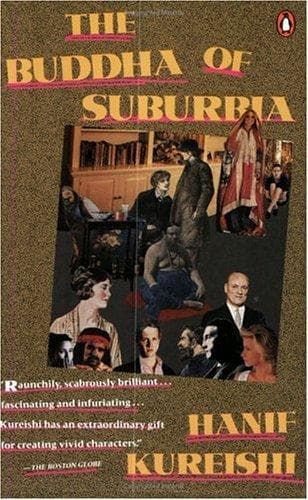
The Buddha of Suburbia
A funny, restless 1970s coming-of-age novel about a mixed-race teenager in south London whose father becomes a guru, worth reading for its sharp comedy about performing identity, class, and desire.
What It's About
The Buddha of Suburbia is Hanif Kureishi's 1990 novel about Karim Amir, a teenager of mixed Indian and English parentage growing up in the outer suburbs of south London in the 1970s. When his father Haroon reinvents himself as a spiritual teacher and gathers a devoted following, Karim watches the family's new pretensions with a mix of embarrassment and fascination. Karim, meanwhile, drifts toward acting, bohemian London, and a restless social life.
The book is first-person and episodic, closer to a loose picaresque than a tightly plotted novel. Scenes move quickly, the dialogue is sharp and often funny, and period details of music, clothes, and politics do much of the work of placing you in the decade. Kureishi writes in an easy, conversational voice that makes the book feel like being told a story by a clever, slightly unreliable friend rather than reading a formal literary work.
The satire is affectionate but not soft. It mocks fashionable spirituality, liberal self-congratulation, and the cult of being authentic, and it does not spare Karim, whose own performances of identity are as suspect as his father's. Reading it is quick and funny, with the serious points about race, class, and belonging arriving through jokes and friction between characters rather than through lectures.
Read this if you…
- enjoy comic, episodic coming-of-age novels with a sharp social eye
- are interested in British multicultural life and identity in the 1970s and 1980s
- like talky, witty dialogue and do not need a tight, driving plot
Skip it if you…
- want a tightly plotted story with a clear arc and a strong ending
- find frank sexual content or the period's casual racism hard to read
Key Ideas
- 1
Identity as a performance
Karim and his father both try on roles, whether Englishness, Indianness, spiritual seriousness, or artistic cool. The novel treats self-invention as a costume that can be worn well or badly, and it is alert to how much of that performance is shaped by what other people expect from a mixed-race young man.
- 2
Suburbia as a stage for class
The move between the suburban family home and the inner-city London scene shows how aspiration, snobbery, and fear of falling behind play out in ordinary social life. The suburbs are not presented as dull, but as a place where people constantly measure themselves against one another.
- 3
Sexual freedom and its costs
Karim's appetites and the period's loosening of sexual norms are central to the book. Kureishi shows the excitement of this freedom alongside its emptiness and its way of making people treat each other as experiences to be collected.
- 4
Satire of spiritual fashion
Haroon's rise as a guru shows how spirituality can become a social currency and a source of status. The book is funny about the followers and the market for enlightenment, but it also takes seriously why people need the promise of meaning.
Limitations
The plot is loose, and the sprawling episodes can feel uneven, especially in the middle. Karim's voice is engaging but often self-absorbed, and some of the book's portrayals of women and sexuality read as dated by today's standards. The period references to music, television, and politics may need explaining for younger readers. Its treatment of race is pointed but occasionally glib, and readers wanting a deeper account of the communities it depicts may find it skims the surface.
Questions Readers Ask
- Is The Buddha of Suburbia still worth reading today?
- Yes, especially if you want a funny, unsentimental look at identity and belonging in Britain. Some attitudes and depictions feel dated, but the sharp observation of family pretence and self-invention still lands. It is short and quick to read, so it works well as an accessible introduction to Kureishi.
- How does it compare with Kureishi's The Black Album?
- The Buddha of Suburbia is looser, funnier, and more episodic, with a coming-of-age focus. The Black Album is more overtly political, concentrating on religion, music, and community conflict in late-1980s London. If you enjoy the first, the second is a more pointed and serious follow-up.
- Do I need to know anything about 1970s Britain before reading?
- You do not need prior knowledge, since the novel gives you enough context through Karim's experiences. A little background on the decade's music, politics, and suburban life will make the references richer, but the book works without it.
- Published
- 1990
- ISBN
- 9782264018199
- Difficulty
- beginner
- Category
- Fiction
Book details and cover from Google Books.
Ready to read The Buddha of Suburbia?
Get your copy on Amazon, or listen to it on Audible. We earn a commission if you buy through these links.