
We earn a commission if you buy through these links. Learn more
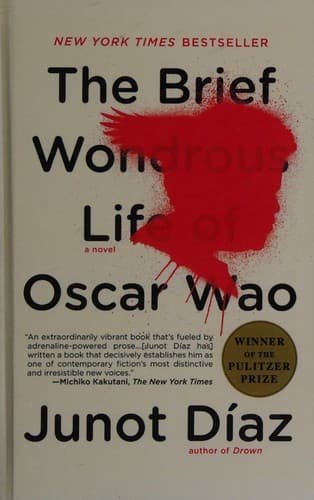
The Brief Wondrous Life of Oscar Wao
by Junot Díaz
Guide by the Books of the Day editors · Updated · How we write our guides
Díaz's Pulitzer-winning novel braids a nerdy New Jersey kid's romantic failures with the long shadow of Dominican dictatorship, told in a voice that is funny, profane, and restless.
What Creators Say About The Brief Wondrous Life of Oscar Wao
2 creators reviewed The Brief Wondrous Life of Oscar Wao on YouTube between 2014 and 2020, with 15.8K views between them. Their opinions are their own; we picked these reviews, we didn't write them.
What It's About
The novel follows Oscar de León, a heavyset, bookish Dominican-American kid growing up in Paterson, New Jersey, who would rather read fantasy and science fiction than date, and who keeps falling for women who do not feel the same way. Much of his story is told by Yunior, a former roommate of Oscar's at Rutgers, who narrates with a mix of affection, grudge, and confession.
The style is the main attraction. Díaz moves between English, Spanish, and Dominican slang, sometimes within a single sentence, and packs in pop culture, genre references, and long digressive footnotes that often carry as much history as the main text. The chapters jump across decades and continents, from New Jersey to the Dominican Republic under the dictator Rafael Trujillo, and the book frames its family's misfortunes through fukú, a curse the narrator traces to the violence of conquest and dictatorship.
Reading it feels like being pulled along by a talkative friend who keeps stopping to explain. It is funny and furious, sometimes in the same paragraph, and it asks what it costs to leave a place and what gets carried across generations. Expect a book that rewards close attention rather than a smooth, linear read.
Read this if you…
- want a novel that mixes comedy, history, and a dense, restless voice
- are interested in diaspora and how dictatorship shapes the families who leave
- are willing to work through untranslated Spanish and footnotes for a richer payoff
Skip it if you…
- want a linear, plain-prose story with little digression or backstory
- are put off by heavy profanity, explicit sexual content, and dense slang
Key Ideas
- 1
Fukú and the inheritance of catastrophe
The novel's central metaphor is fukú, a curse the narrator links to the New World's history of conquest, slavery, and dictatorship. Díaz treats it partly as a joke and partly as a serious way to explain why some families seem to get hit again and again. Its counterpart, zafa, is a counter-charm that the book takes just as seriously.
- 2
Trujillo's shadow over a New Jersey family
The Dominican dictatorship is not background scenery. It reaches into the family's choices, fears, silences, and departures, and it shows how political terror travels through marriages and migrations. The history of an island becomes the private history of a household.
- 3
Language that switches without warning
Spanish, English, Dominican slang, and Spanglish sit side by side, often without translation. Readers with little Spanish will sometimes be lost, and the footnotes help without always clarifying. The effect is a faithful picture of bilingual life, where meaning often lives in the switch between languages.
- 4
Footnotes that act as a second narrator
The long, digressive footnotes carry history, genre commentary, and family backstory, and they can be funnier or sadder than the main text. They are part of the experience, and skipping them means missing a whole layer of the book.
Limitations
Critics have pointed to the narrator's treatment of women, which many readers find objectionable. Several female characters are defined mainly by their relationships to Oscar and to men, and the book's view of them is often filtered through Yunior's own failings. Dense slang and untranslated Spanish can exclude readers, and some find the footnotes showy. The curse framework can also feel heavy-handed to readers who want the realism to carry more of the weight.
Questions Readers Ask
- Do I need to know Dominican history or Spanish to read it?
- You do not need either to enjoy the book, but both help. Díaz translates very little, and the footnotes supply history about Trujillo and the island without explaining every phrase. Readers with some Spanish, or who are willing to look up words as they go, will get the most out of it.
- Is it still relevant?
- Yes. Its concerns with migration, inherited trauma, and how histories of dictatorship shape immigrant families remain current. Some pop culture and technology references from its 2007 publication feel dated, but the emotional core holds up well.
- Should I read Díaz's earlier book first?
- Drown, his 1996 collection of linked stories, also features Yunior and many of the same concerns about family, migration, and masculinity. It can serve as a gentler entry point to his voice, though it is not required reading before the novel.
- Published
- 2007
- ISBN
- 9782264049995
- Difficulty
- intermediate
- Category
- Fiction
Book details and cover from Google Books.
Ready to read The Brief Wondrous Life of Oscar Wao?
Get your copy on Amazon, or listen to it on Audible. We earn a commission if you buy through these links.