
We earn a commission if you buy through these links. Learn more
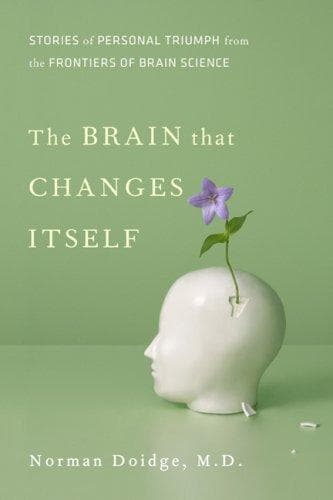
The Brain That Changes Itself
A readable, story-driven tour of how the adult brain rewires itself, through stroke patients, phantom pain, and inventive scientists, that still rewards readers curious about what neuroscience was discovering.
What It's About
The Brain That Changes Itself, published in 2007, is a popular survey of neuroplasticity, the idea that the adult brain's wiring is shaped by experience and can be reorganized after injury or during learning. Norman Doidge, a psychiatrist and psychoanalyst who writes for general readers, builds the book around case histories and visits to researchers working at the edges of neuroscience. It is organized by stories and experiments rather than by a single thesis or a set of exercises.
The style is narrative and conversational. Each section centers on a scientist or patient whose story illustrates a mechanism: a device that converts camera images into touch on the tongue, a stroke patient who regains use of a limb through forced practice, or a mirror that tricks the brain out of phantom pain. Doidge explains the experiments in plain language and keeps returning to the hopeful implication that the brain can heal, learn, and recover at ages once thought too late. Reading it feels closer to listening to a long, enthusiastic lecture by a gifted storyteller than to working through a textbook.
It is an uneven book in a useful way. The stories are vivid and the underlying science is real, but Doidge leans toward the dramatic, and some passages compress messy findings into triumphant narratives. Readers who want careful methods, effect sizes, or critical evaluation will need other sources. Readers who want a broad sense of what researchers were learning about change in the brain will find it engaging.
Read this if you…
- want an accessible, story-driven introduction to neuroplasticity
- are curious about stroke recovery, phantom pain, or learning later in life
- prefer science told through people and experiments rather than data tables
Skip it if you…
- want practical exercises or a step-by-step program for rewiring your own brain
- need a critical, evidence-focused account with careful caveats about study quality
Key Ideas
- 1
The adult brain is not fixed
For much of the twentieth century, the adult brain was assumed to be largely hardwired after childhood. Doidge traces experiments showing that cortical maps, the brain's representations of the body and senses, shift in response to practice, use, and injury. This challenged a deeply held assumption and remains the book's central argument.
- 2
Use it or lose it, in both directions
The same mechanism that allows recovery and skill-building can also entrench unwanted patterns, such as chronic pain or compulsive habits. Doidge argues that neglected connections weaken while repeated ones strengthen, so the brain's plasticity is neutral and can work for or against us.
- 3
Sensory substitution and the brain's flexibility
Several devices in the book route information from one sense into another, such as vision translated into touch. The striking point is that the brain learns to interpret these unfamiliar signals as meaningful experience, which suggests the cortex responds more to the kind of information it receives than to the organ it arrives through.
- 4
Attention and repetition as drivers of change
Doidge repeatedly stresses that change depends on focused, sustained effort rather than passive exposure. Intensive practice, attention, and motivation appear again and again as conditions under which the brain reorganizes, which gives the book a practical undertone even though it is not a how-to guide.
Limitations
The book's enthusiasm is both its appeal and its weakness. Many examples are individual cases or early experiments, and some have since been refined, complicated, or questioned by later research. Certain therapies described with optimism have been criticized for overstating their benefits. Doidge covers less of the molecular biology behind plasticity and says little about the limits of change, so readers may come away with a more hopeful picture than the evidence fully supports.
Questions Readers Ask
- Is The Brain That Changes Itself still relevant after new research?
- Yes, mainly for its core idea that the brain changes with experience, which is now well supported. Some specific examples and early claims have been refined since 2007, and certain therapies have been tested more rigorously. Treat the book as an engaging overview of the field's direction rather than a current summary of settled findings.
- Does the book give exercises to rewire your brain?
- Not really. It describes experiments and therapies, and it draws general lessons about practice, attention, and repetition, but it does not offer a program you can follow at home. Readers looking for actionable steps will want a dedicated self-help or rehabilitation resource.
- How does it compare to Oliver Sacks's case-study books?
- Both use patient stories to explain unusual neurology in accessible prose. Doidge focuses more tightly on one theme, plasticity, and leans toward the hopeful and dramatic, while Sacks tends to explore a wider range of conditions with more reflective, personal observation.
- Published
- 2007
- ISBN
- 9780141923680
- Difficulty
- beginner
- Category
- Psychology
Book details and cover from Google Books.
Ready to read The Brain That Changes Itself?
Get your copy on Amazon, or listen to it on Audible. We earn a commission if you buy through these links.