
We earn a commission if you buy through these links. Learn more
The Boy Who Harnessed the Wind
by William Kamkwamba, Bryan Mealer
A Malawian boy who learned physics from library books builds a windmill from junk to bring power to his famine-struck family, in a memoir of ingenuity and hope.
What It's About
The Boy Who Harnessed the Wind is a memoir written with the journalist Bryan Mealer, covering William Kamkwamba's childhood in Wimbe, a village in central Malawi. It opens against the backdrop of drought and food shortage in the early 2000s, when the family's harvests failed and money for school fees disappeared. Kamkwamba left school as a teenager and spent much of his time in a small library, where he worked through a physics textbook meant for a more advanced reader.
The writing is plain and direct, closer to a long conversation than a technical manual. Village life comes through in its daily rhythms: planting, hunger, family obligations, and the local beliefs that shape how people respond to misfortune. Kamkwamba's engineering is explained at a level a general reader can follow, so no background in science is needed to keep up.
Reading it is less the story of a prodigy than of persistence under hard limits. The early chapters move slowly through poverty, while the building sections carry real tension, because each failed attempt costs time and materials that the family can barely spare. It leaves a clear sense of how much invention is improvisation with whatever is already at hand.
Read this if you…
- want a true-life story of ingenuity under real hardship
- are curious how ordinary materials can become working technology
- enjoy memoirs that show everyday life in rural Africa with honesty and care
Skip it if you…
- want a detailed technical guide to building wind turbines
- prefer memoirs that are sharply literary or highly introspective
Key Ideas
- 1
Learning from whatever books you can find
Kamkwamba's education happened largely outside school, through a few books he could borrow. The memoir shows how much a motivated reader can extract from incomplete resources, and how a textbook can open a door when no teacher is available. It also shows the gap between knowing a principle and having the tools to test it.
- 2
Scarcity as a spur to improvisation
Much of the windmill is built from salvaged parts, including bicycle components, scrap pipe, and materials gathered from around the village. The book treats this improvisation as a skill grounded in necessity rather than a clever trick. Each workaround reveals how engineering thinking can start from what is locally available.
- 3
The real cost of losing schooling
The memoir is candid about what a family crisis does to a child's education. Leaving school is not presented as a romantic escape but as a loss that Kamkwamba felt for years. This gives the book's achievements a more sober weight, since they grew out of a setback rather than a plan.
- 4
Hope as practical rather than sentimental
The book's optimism is tied to concrete action: a project, a test, a repair, another attempt. Readers who expect uplift without grit may find this refreshing. The hope on display is less a feeling than a habit of trying again after things fail.
- 5
Village knowledge and outside attention
The story also raises questions about how outsiders notice and celebrate local innovation, and how that attention changes a community. The memoir does not resolve these questions neatly, which leaves room for readers to think about aid, recognition, and who gets credit for ideas.
Limitations
Some readers find the narrative simplified, a result of its reliance on a co-writer and a single perspective on a complex community. The book's upbeat framing can make hardship feel more resolvable than it was. Its engineering is kept deliberately light, so it will not teach you how to build a working turbine. Later life and the wider context of Malawi's economy and development get far less space than the childhood years, and readers wanting that broader picture will need other sources.
Questions Readers Ask
- Is The Boy Who Harnessed the Wind suitable for teenagers?
- Yes, it is widely read by younger readers. The language is accessible and the story centers on a teenager facing real choices about school and family. It does touch on famine, poverty, and the loss of education, so it works best for readers who can handle serious subject matter, though it contains nothing graphic.
- Do I need any science background to enjoy it?
- No. The physics appears in short, plain explanations tied to what the author is trying to build. You will follow the broad logic of the windmill without difficulty. If you want precise technical detail, you will need to look elsewhere, since the book keeps its engineering at the level of story.
- How does it compare to other books about village innovation?
- It is more personal and narrative-driven than most books in this area, which tend to be reports or policy studies. Readers who enjoy first-person accounts of resourcefulness will find it engaging. Those seeking analysis of development economics may want a more academic book alongside it.
- Published
- 2009
- ISBN
- 9780061937675
- Difficulty
- beginner
- Category
- Biographies
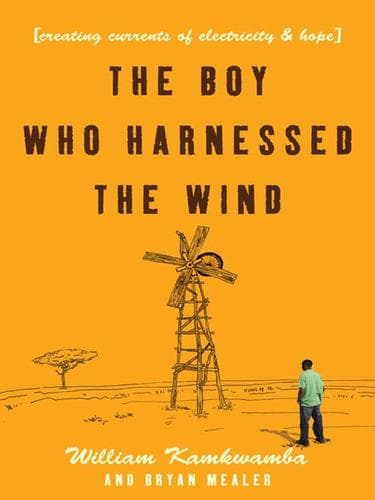
Book details and cover from Google Books.
Ready to read The Boy Who Harnessed the Wind?
Get your copy on Amazon, or listen to it on Audible. We earn a commission if you buy through these links.