
We earn a commission if you buy through these links. Learn more
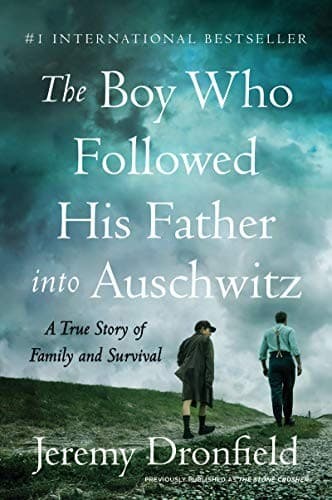
The Boy Who Followed His Father into Auschwitz
A Holocaust history built around a boy who chose to go with his father into Auschwitz, offering a personal, close-range route into one of the twentieth century's most documented atrocities.
What Creators Say About The Boy Who Followed His Father into Auschwitz
2 creators reviewed The Boy Who Followed His Father into Auschwitz on YouTube between 2019 and 2020, with 18.6K views between them. Their opinions are their own; we picked these reviews, we didn't write them.
What It's About
The title sets the premise: a boy who follows his father into Auschwitz, placing a young person at the center of one of the most documented crimes of the twentieth century. Books in this area tend to work in one of two ways. Some survey the whole camp system, while others narrow to a single family or set of testimonies to make a vast history concrete. Judging by its title and category, this book belongs to the second kind, using one personal thread to carry the larger story.
I know this book less well than I would like, so what follows relies mainly on the title, the author's name, and the general shape of Holocaust narrative writing rather than on detailed knowledge of its contents. Expect narrative history rather than a theoretical argument. The reading experience is likely to be emotionally heavy, with pacing driven by individual days, decisions, and losses rather than by statistics or political analysis.
Before committing, check a current description or sample to confirm how the story is sourced, how much is reconstructed, and how the family's background is handled. Readers who want a wider frame will get more from pairing it with a general history of the camps.
Read this if you…
- want a human-scale account of the Holocaust rather than a sweeping overview
- are drawn to family stories that confront the moral limits of survival
- can handle sustained emotional weight and want history that stays close to individuals
Skip it if you…
- want a comprehensive analysis of how the Nazi state and camp system operated
- need a reconstructed, fully documented account with extensive scholarly apparatus and source notes
Key Ideas
- 1
A young person's view of the camps
The central choice of the title places a child or adolescent inside the camp system, so the reader sees persecution through eyes that are still forming. This perspective tends to make abstract institutional cruelty feel immediate and personal. Watch for how the author handles what a boy could understand and what he could not.
- 2
Family bonds under extreme pressure
A father and son facing the same destination raises questions about protection, responsibility, and what it means to stay together when survival is uncertain. The book's emotional weight likely rests on these relationships. Pay attention to how decisions made inside the family are framed, and to the moral complexity of choices made under coercion.
- 3
Personal testimony within documented history
Work built on one family's experience has to balance intimate detail with the wider historical record. Good books in this vein show how a single life connects to documented policies, transports, and camp routines. Consider whether the author anchors the personal account in verifiable context, and whether that anchoring feels honest rather than decorative.
Limitations
I cannot confirm the book's sourcing, its use of family records or testimony, or how much dialogue and interior detail is reconstructed, so readers who care about evidentiary rigor should check this directly. Personal narratives of this kind can be powerful but may trade breadth for intimacy, leaving the wider system less fully explained. The emotional intensity is high and may be difficult for some readers, and the book's subject matter is well covered elsewhere, so its distinctiveness depends on how well the author handles that single story.
Questions Readers Ask
- Who is this book best suited for?
- It suits readers who want to understand the Holocaust through individual lives rather than broad policy, and who are comfortable with heavy material. It is a reasonable entry point for general adult readers. Readers wanting detailed analysis of the camp system may find it too narrow and should look for a more comprehensive history alongside it.
- Is this book a good starting point for learning about Auschwitz?
- It can be, though it works best as one part of a broader reading plan. A personal narrative gives emotional entry, while a general history supplies the wider structure, timeline, and context. Reading both gives a fuller picture than either would alone.
- How does it compare to other Holocaust memoirs?
- I cannot make a confident detailed comparison without being sure of the book's contents. In general, works in this genre differ in how closely they rely on survivor testimony and how much they add historical context. Check a current description to see where this one falls on that spectrum.
- Published
- 2019
- ISBN
- 9780063236189
- Difficulty
- intermediate
- Category
- History
Book details and cover from Google Books.
Ready to read The Boy Who Followed His Father into Auschwitz?
Get your copy on Amazon, or listen to it on Audible. We earn a commission if you buy through these links.