
We earn a commission if you buy through these links. Learn more
The book of strange new things
by Michel Faber
Guide by the Books of the Day editors · Updated · How we write our guides
A quiet, unsettling literary science fiction novel about a missionary's faith, and a marriage stretched across a growing distance, that asks what devotion costs.
What Creators Say About The book of strange new things
2 creators reviewed The book of strange new things on YouTube between 2019 and 2026, with 5.7K views between them. Their opinions are their own; we picked these reviews, we didn't write them.
What It's About
The Book of Strange New Things follows Peter Leigh, a devout man hired by a large corporation to serve as the spiritual minister to a small human settlement on Oasis, a planet far from Earth. The settlement sits alongside a native population whose language Peter slowly learns, and whose interest in his Bible surprises him. He leaves behind his wife, Bea, who stays on Earth, and the novel is built around the letters and messages that pass between them.
Faber writes in plain, observational prose, and the book stays close to Peter's point of view. The world-building is deliberately light. Technology, politics, and the mechanics of space travel are largely background, while the attention falls on daily routines, conversations, and the moral weight of small decisions. The Earth strand arrives in fragments, so its troubles feel distant and partly unknown, which mirrors Peter's own position.
Reading it is a slow, reflective, and often emotionally heavy experience. It rewards patience and close attention to tone. Its tenderness and its dread tend to arrive together, and it leaves questions about faith, loyalty, and what it means to take care of strangers rather than answering them neatly.
Read this if you…
- are interested in faith and doubt explored without easy answers
- want literary science fiction that cares more about people than gadgetry
- have been separated from someone you love and know how distance changes a relationship
Skip it if you…
- want a fast plot, action, or space adventure
- need clear explanations of how the planet, the technology, or the corporation actually work
Key Ideas
- 1
Faith carried into unfamiliar ground
Peter's religion is not presented as a set of easy comforts. The novel examines what a belief system does when it meets a culture that has no reason to share its assumptions, and what the believer must give up or hold onto in return.
- 2
Love stretched across vast distance
The correspondence between Peter and Bea is the emotional spine of the book. Faber shows how communication lags, thins, and changes meaning when two people are separated by more than miles, and how hope can persist even as the letters become harder to write.
- 3
Corporate mission and the ethics of expansion
The settlement exists because a company needs it to. The novel quietly questions who benefits from outposts like Oasis, and whether the people sent to serve them are also being used, even when their intentions are sincere.
- 4
The limits of understanding the other
The Oasans are never reduced to monsters or symbols. Their otherness is real, and Peter's attempts to understand them are both admirable and inadequate. The book is attentive to how much of another mind can be reached through language and goodwill.
Limitations
The pace is slow, and many readers find the middle stretches static. Because the story stays with Peter, the crises on Earth reach us secondhand and in fragments, which some will find frustrating rather than haunting. The world-building is intentionally thin, so anyone expecting detailed science fiction ideas may feel shortchanged. The religious perspective is mainly Christian and centred on one character's inner life, which may limit its appeal for readers who want a broader view of belief or of the Oasan culture.
Questions Readers Ask
- Is The Book of Strange New Things really science fiction?
- It is set on another planet and uses science fiction premises, but the genre is a frame rather than the focus. The story concerns faith, marriage, and the ethics of colonial outposts. If you come to it expecting detailed technology or alien spectacle, you may be disappointed, but readers of literary fiction will find it more familiar.
- How does it compare to Ted Chiang's work on alien contact?
- Both novels treat first contact as a question of language and mutual understanding rather than conflict. Chiang tends toward precise, idea-driven stories, while Faber's book is warmer, more domestic, and more emotionally focused on one man's private struggle.
- Published
- 2014
- ISBN
- 9780553418866
- Difficulty
- intermediate
- Category
- Fiction
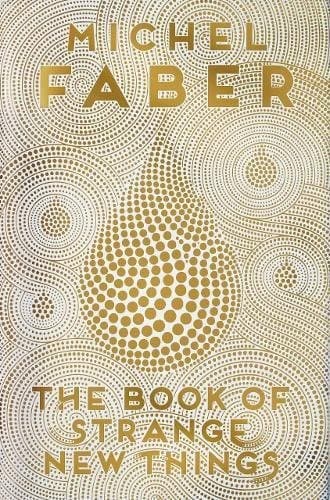
Book details and cover from Google Books.
Ready to read The book of strange new things?
Get your copy on Amazon, or listen to it on Audible. We earn a commission if you buy through these links.