
We earn a commission if you buy through these links. Learn more
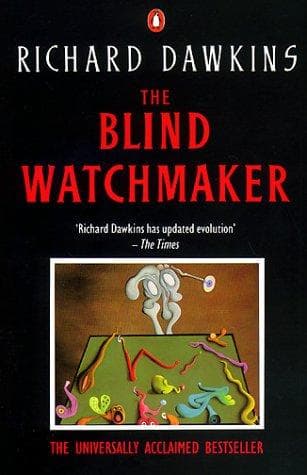
The Blind Watchmaker
Guide by the Books of the Day editors · Updated · How we write our guides
A clear, combative case that natural selection can build eyes and other complex life without a designer, and still one of the best introductions to evolutionary reasoning.
What Creators Say About The Blind Watchmaker
2 creators reviewed The Blind Watchmaker on YouTube between 2018 and 2026, with 27.4K views between them. Their opinions are their own; we picked these reviews, we didn't write them.
What It's About
The Blind Watchmaker, published in 1986, takes on the old argument that complex living things, such as the eye, must have been designed in the way a watch implies a watchmaker. Richard Dawkins answers with natural selection, which he presents as a process that builds complexity by accumulating small changes over many generations. The book is a sustained case for why that process is enough, and why it is not chance acting alone.
Dawkins writes clearly and with evident enjoyment of argument. He relies on thought experiments, analogies, and a computer program he wrote to generate branching, tree-like shapes, which he called biomorphs, to show how a simple rule applied repeatedly can produce surprisingly intricate results. Much of the book concerns the eye, the number of steps needed to get from a light-sensitive patch to a lens, and why each intermediate stage can still be useful to its owner.
The experience is less a textbook than a long, pointed essay. Expect direct sparring with opponents, a confident tone, and examples drawn from animals, insects, and bats. It rewards readers who like following a chain of reasoning one link at a time, and it works best as a clear account of how selection operates and why it is not the same as randomness.
Read this if you…
- want a clear, step-by-step case for how natural selection produces complex structures like the eye
- are curious about why evolution is often misunderstood as random chance
- enjoy sharp, opinionated nonfiction that takes on opponents directly
Skip it if you…
- want a neutral survey of evolutionary biology or the latest research
- prefer science writing that avoids polemic and personal argument
Key Ideas
- 1
Cumulative selection beats pure chance
Dawkins's central move is to separate a single random shot at complexity from a process that keeps what works and builds on it. Improbable outcomes become likely when each step is small and preserved. Much of the book is an effort to make this distinction feel obvious rather than merely asserted, so readers come away able to see where a critic's probability argument goes wrong.
- 2
Why the eye is a test case
The eye is the example critics press hardest, since a half-formed eye looks useless. Dawkins argues that light sensitivity, then a cup of pigmented cells, then a focusing structure each offer some advantage along the way. He treats this as a traceable sequence rather than a leap, and the chapters on it are the most concrete part of the argument.
- 3
Where the watchmaker analogy breaks down
Paley's watch works because a designer can see the whole target in advance. Selection has no foresight and no goal, only differences in survival and reproduction from one generation to the next. Dawkins uses this contrast to explain why design-like results can arise without a designer, and he is most persuasive when he makes the reader feel the gap between those two kinds of process.
- 4
Simple rules, complex outcomes
The biomorph program shows, in a way that is easy to picture, how a short set of rules applied again and again can yield forms that look planned. The example is not a model of real biology, and Dawkins is careful about that. Its value is in building intuition for how complexity can emerge from iteration instead of from a blueprint.
- 5
Selection acts through the gene
Dawkins treats the gene as the unit that persists across generations, while the organism is the vehicle through which selection operates. This framing shapes much of his reasoning about heredity and adaptation. Readers who meet it here will see it developed further in his later work, and it is worth understanding on its own terms before deciding whether to accept it.
Limitations
The book is openly polemical, written against creationist and design arguments of the 1980s, so some readers will find the tone combative and the targets dated. Its treatment of the fossil record and of the broader history of life is limited, and later research on developmental biology, neutral genetic change, and gene regulation has added detail that the book does not cover. The biomorph program is an illustration rather than a model of real organisms, and some critics argue the book's gene-centred framing gets more emphasis than the evidence strictly requires.
Questions Readers Ask
- Do I need a biology background to read The Blind Watchmaker?
- No. Dawkins explains the core ideas from first principles and uses everyday analogies. Some passages on the eye and on genetic inheritance go into more detail, so a willingness to slow down and follow the logic is helpful. Prior knowledge of basic evolution will make the argument feel more familiar, but it is not required.
- How does it compare to The Selfish Gene?
- The Selfish Gene is the broader, more famous statement of the gene-centred view, while The Blind Watchmaker focuses on one target: the claim that complex design requires a designer. Readers who want the big picture of genes and behaviour may prefer The Selfish Gene first, while readers interested in the logic of adaptation will find this book more focused.
- Is The Blind Watchmaker still relevant today?
- The core argument about cumulative selection remains standard in evolutionary biology, so the book still explains the logic well. Some of the specifics, including the fossil evidence and the state of molecular biology, have moved on, so it is best read as a foundation rather than an up-to-date survey.
- Published
- 1986
- ISBN
- 9780140291223
- Difficulty
- intermediate
- Category
- Science
Book details and cover from Google Books.
Ready to read The Blind Watchmaker?
Get your copy on Amazon, or listen to it on Audible. We earn a commission if you buy through these links.