
We earn a commission if you buy through these links. Learn more
The Awakening
by Kate Chopin
Guide by the Books of the Day editors · Updated · How we write our guides
A short, sharp novel about a married woman in 1890s New Orleans who begins wanting a self of her own, and whose questions still feel startlingly modern.
What Creators Say About The Awakening
2 creators reviewed The Awakening on YouTube between 2019 and 2020, with 158.6K views between them. Their opinions are their own; we picked these reviews, we didn't write them.
What It's About
The Awakening follows Edna Pontellier, a wife and mother in a wealthy Creole circle in New Orleans, across a summer at the seaside and the months that follow. Her husband is attentive in ways that mostly amount to control. Her children are loved, but they feel like obligations she never agreed to. Society has a script for her, and she slowly stops following it. Chopin shows this mostly through small scenes: a swim, a card game, an evening of music, a conversation that goes slightly wrong.
The prose is spare and observant, staying close to Edna's perception with little commentary from the narrator. Chopin trusts readers to notice what Edna notices and to feel the gap between what people say and what they mean. The surface is clean and unshowy, but recurring images, especially of the sea and of music, carry much of the emotional weight.
Reading it is less like following a plot than sitting close to someone changing her mind about nearly everything at once. It is short enough to finish in a couple of sittings, but its meaning builds as you go. Many readers finish it still arguing with it, and that unresolved quality is a large part of its staying power.
Read this if you…
- want a short, serious novel about a woman's inner life
- are curious how fiction handled women's independence before the twentieth century
- like ambiguous endings that keep you thinking long after the last page
Skip it if you…
- want a fast plot with clear cause and effect from start to finish
- find slow, interior, mood-driven prose tiring rather than absorbing
Key Ideas
- 1
Selfhood pressing against the expectations of marriage
Edna's central problem is not a single bad marriage but the sense that her identity has been folded into being someone's wife. Chopin lets you see how small domestic courtesies can feel like a slow erasure. The novel asks what a person owes to a role she never fully chose, and what happens when she starts to see the role clearly.
- 2
Motherhood as duty versus genuine desire
Edna loves her children, yet she does not feel the constant, self-erasing devotion that her world treats as natural. Chopin presents this without easy judgment. The book is useful for seeing how motherhood was framed as a moral identity in its era, and how an honest feeling of distance could be read as a scandal.
- 3
Art, music, and a private inner life
Music and painting matter in the novel because they give Edna access to feelings and standards that her social world does not supply. The novel treats art less as decoration than as a kind of truth-telling. Watching her respond to a piece of music often tells you more about her than any speech she makes.
- 4
Class codes and the limits of freedom
Edna's wealth gives her room to rebel, but it also binds her to the rules of an elite circle that watches everything. Chopin shows how reputation, propriety, and social standing shape what a woman can do. The freedom Edna reaches for is real but constrained, and the novel is precise about where those constraints sit.
Limitations
Critics in 1899 were largely hostile, and the novel's reputation took decades to recover, so its early reception is part of its history rather than a verdict on its quality. Modern readers often note that the book's world is narrow. It centers white, upper-class Creole characters, and Black characters appear mostly in the background. Some find the pacing deliberate to the point of slowness, and the ending remains a point of argument, which some readers will find frustrating rather than rewarding.
Questions Readers Ask
- Is The Awakening still worth reading today?
- Yes, especially if you want to see how a late nineteenth-century writer handled desire, selfhood, and marriage with real precision. Its sentences are not difficult, and it is short. The main challenge is emotional and interpretive rather than technical, since Chopin leaves a good deal for you to work out yourself.
- How does it compare to Madame Bovary?
- Chopin was clearly influenced by Flaubert, and the two books share a focus on a restless woman tested by marriage and social expectation. The Awakening is much shorter, more lyrical about sensation and the sea, and less ironic in its narration. If you liked Flaubert's precision, you may find Chopin's quieter, more intimate approach rewarding.
- Is it a feminist novel?
- It is often read that way, and its concerns with autonomy and identity are central to it. Still, Chopin is more interested in a woman's inner experience than in offering a program. Readers who want an argument may be less satisfied than those who want to watch a character think her way through a difficult life.
- Published
- 1899
- ISBN
- 9781673298109
- Difficulty
- intermediate
- Category
- Fiction
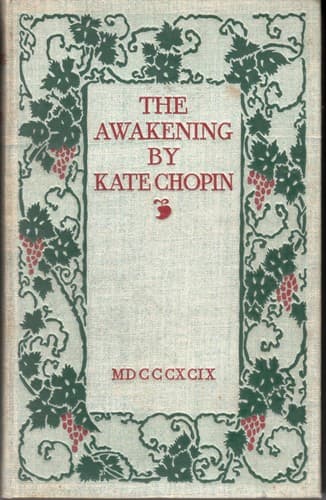
Book details and cover from Google Books.
Ready to read The Awakening?
Get your copy on Amazon, or listen to it on Audible. We earn a commission if you buy through these links.