
We earn a commission if you buy through these links. Learn more
The Autumn of the Patriarch
Guide by the Books of the Day editors · Updated · How we write our guides
García Márquez's unforgiving portrait of a dictator's loneliness, told in sentences so long and shifting they feel like a fever. Worth it if you can handle the pace.
What Creators Say About The Autumn of the Patriarch
2 creators reviewed The Autumn of the Patriarch on YouTube between 2021 and 2026, with 10.3K views between them. Their opinions are their own; we picked these reviews, we didn't write them.
What It's About
The novel follows an unnamed dictator who rules an imagined Caribbean nation through what seems like an endless old age. He holds absolute power yet struggles to grasp that it is slipping away around him. García Márquez refuses to tell the story in a straight line. Events from different decades collide, and the narration moves between the Patriarch's own consciousness, the bewildered voices of the people who live under him, and a collective we that sounds like a crowd passing rumors back and forth.
The style is the main event. Sentences run for pages, clauses pile up, and whole sections can pass without a conventional break. Reading it feels less like following a plot than like wandering through a crowded market in the heat, where the mood can shift from farce to grief within a single line. Much of the book's force comes from accumulation rather than any one scene, so the experience builds slowly and then lingers.
Expect to slow down and reread. The book rewards patience with a portrait of how authority isolates the person who holds it, and how a population learns to live with a tyrant as if he were a condition of the weather. It is less about one country than about the shape of dictatorship in general, which is why it still feels pointed.
Read this if you…
- want a serious, unusually inventive novel about dictatorship and its quiet complicity
- enjoy long, musical sentences and are willing to work for them
- liked One Hundred Years of Solitude and want to see the political side of that world more starkly
Skip it if you…
- need a clear plot, a sympathetic protagonist, or a steady narrative line
- find dense, unbroken prose exhausting or are reading mainly for story
Key Ideas
- 1
Power that cuts its holder off
The Patriarch is surrounded by flatterers, informers, and people who tell him what he wants to hear. García Márquez shows how absolute authority leaves him unable to know what his subjects really think, and how that blindness becomes a kind of prison. His loneliness is the emotional core of the book, even when he is at his most cruel.
- 2
The people as a murmuring chorus
The collective we voice gives the population a presence that is part witness, part gossip, and part accomplice. Ordinary people fear, mock, and quietly go along with the regime, and the novel does not let readers treat them as innocent bystanders. This shared voice is one of the book's most distinctive techniques.
- 3
Time that folds back on itself
Past and present, and decades of rule, blur together, so the Patriarch's old age feels both endless and oddly unmoored. The nonlinear structure mirrors his disordered memory and the way a long regime erases the line between history and rumor. Readers should expect to piece together chronology themselves.
- 4
Grotesque humor beside real horror
Much of the book is darkly comic, full of absurd excess and bodily decay. The comedy never cancels the violence it describes, and the laughter often turns sour as the reader sees what the humor is covering. This tonal mix is what keeps the novel from feeling merely bleak.
Limitations
The prose is famously demanding, and many readers find the constant shifts in voice and time disorienting rather than rewarding. The Patriarch is deliberately hard to like, which some readers find alienating. Because the setting is an unnamed Caribbean state, critics sometimes say the dictatorship feels more like a composite of Latin American regimes than a fully rooted portrait. The repetition of grotesque imagery can also wear thin over a book of this length.
Questions Readers Ask
- Do I need to read One Hundred Years of Solitude first?
- No. The novels are connected by a shared region and a taste for long, layered storytelling, but each stands on its own. Reading One Hundred Years of Solitude first may help you recognize some of the author's recurring preoccupations, yet it is not required. The Autumn of the Patriarch is darker, more political, and more claustrophobic, so starting with it is a valid choice.
- Is The Autumn of the Patriarch still relevant today?
- Yes. The book is about how power isolates leaders and how ordinary people learn to live with authoritarian rule, themes that remain current. Its references to specific mid-twentieth-century Latin American history are background, and the novel's focus on the mechanics of dictatorship travels well beyond that setting.
- Published
- 1977
- ISBN
- 9780060882860
- Difficulty
- advanced
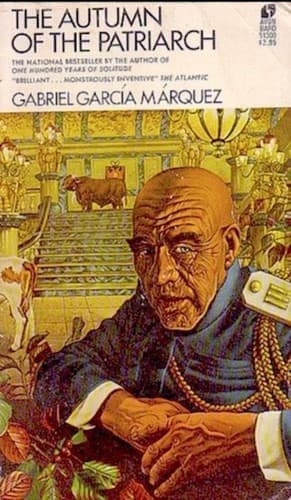
Book details and cover from Google Books.
Ready to read The Autumn of the Patriarch?
Get your copy on Amazon, or listen to it on Audible. We earn a commission if you buy through these links.