
We earn a commission if you buy through these links. Learn more
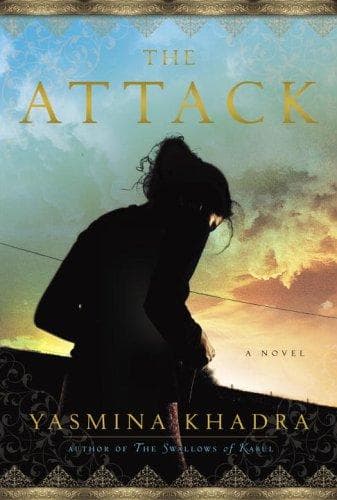
The Attack
Guide by the Books of the Day editors · Updated · How we write our guides
A respected Arab-Israeli surgeon's comfortable life in Tel Aviv falls apart when his wife becomes the prime suspect in a suicide bombing, forcing him to confront what he never wanted to see.
What It's About
The Attack is a novel about a man who believed he had found a safe place between two worlds. Amin Jaafari is a successful Arab surgeon living in Tel Aviv, with Jewish colleagues, a comfortable home, and a habit of treating politics as something that happens to other people. When a bombing in a crowded restaurant kills and maims civilians, the police come to him with a question he cannot answer: his wife may have been involved.
Khadra, the pen name of the Algerian writer Mohammed Moulessehoul, builds the book as an investigation. Much of it is Amin trying to reconstruct the woman he married, moving between hospital wards, police interviews, and the Palestinian places she may have visited. The prose is direct and lean, with the momentum of a crime novel, but the real engine is moral. Each discovery forces Amin to reconsider what he has been willing to overlook.
Reading it feels less like following a plot than sitting with a man who is losing his footing. Expect long stretches of reflection, sharp observations about daily life under occupation and inside Israeli society, and a narrator whose self-deception is part of the point. It asks uncomfortable questions and does not hand out tidy answers.
Read this if you…
- Want a novel that approaches the Israeli-Palestinian conflict through one family's experience rather than position papers
- Like psychologically driven stories where the central question is who you are, not only what happened
- Are interested in how ordinary people rationalise staying silent when their world is under strain
Skip it if you…
- Want a balanced, neutral history of the conflict, since this is a single man's deeply personal view
- Need a tidy plot resolution, because the ending is deliberately unsettling and leaves much unexplained
Key Ideas
- 1
Belonging to neither side fully
Amin is an Arab citizen of Israel who has worked hard to be accepted, yet he is never quite trusted by either community. The book shows how assimilation can become a form of hiding, and how a person who avoids taking sides can still be judged for the side he is assumed to be on.
- 2
War entering the private home
The bombing does not stay on the news. It reaches into a kitchen, a marriage, and a friendship. Khadra is interested in how a public conflict reshapes intimate life, including what couples tell each other and what they choose not to ask.
- 3
Suspicion as a form of violence
Accusation can wound people long before any proof exists. The novel tracks how police attention, neighbours' glances, and collective blame change the way Amin sees himself and how others treat him, making the cost of suspicion feel as real as the explosion.
- 4
Knowing someone versus believing you know them
The investigation is really a study of intimacy. Amin discovers that the person he thought he understood had a hidden inner life, and the novel asks how much any of us can truly know about the people closest to us.
- 5
Lean style with a moral pull
The narration is spare and fast-moving, closer to a thriller than a political treatise. That pacing makes the ideas land harder, because the book keeps returning to the question of what a decent person owes to the people around him and to the truth.
Limitations
The book is told from a single, privileged perspective, and Amin can be self-absorbed, which some readers find frustrating. Critics also note that the political arguments sometimes feel like the author speaking through his characters rather than emerging naturally from the story. The middle sections can feel repetitive as Amin circles the same questions. The novel is rooted in the intifada-era Israel of the early 2000s, so its details of checkpoints, security policy, and public mood reflect that period, and readers coming to it now may need some context.
Questions Readers Ask
- Is The Attack based on a real event?
- No. The bombing and the characters are fictional, though Khadra draws on the broader reality of suicide attacks and the Israeli-Palestinian conflict of the early 2000s. It reads as a plausible portrait of that climate rather than a documentary account of any specific incident.
- How does The Attack compare to other novels about the conflict?
- If you have read Amos Oz's novels about Israel, The Attack offers a sharper look from the perspective of an Arab citizen of Israel, with more tension and less family saga. It is shorter and more propulsive, and it focuses on one marriage under unbearable pressure.
- Do I need background knowledge before reading?
- Not necessarily. The novel supplies enough context for a general reader to follow the story. Some basic knowledge of the intifada and the situation of Arab citizens of Israel will deepen your reading, but it is not required.
- Published
- 2005
- ISBN
- 9780385514798
- Difficulty
- intermediate
- Category
- Fiction
Book details and cover from Google Books.
Ready to read The Attack?
Get your copy on Amazon, or listen to it on Audible. We earn a commission if you buy through these links.