
We earn a commission if you buy through these links. Learn more
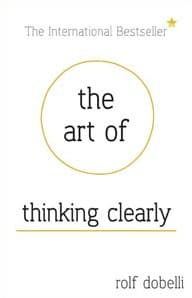
The art of thinking clearly
A brisk, practical tour of 99 common thinking errors, each explained in a few pages, that makes a good first introduction to cognitive biases for busy readers.
What It's About
The Art of Thinking Clearly is a nonfiction collection of 99 short essays, each built around one cognitive bias or reasoning error, such as survivorship bias, the sunk cost fallacy, or the halo effect. Despite the Fiction category on this listing, it is not a novel. It is popular psychology and practical decision-making, originally written in German and widely read in translation.
Each entry follows a similar pattern: a name for the error, a short story or example drawn from business, history, or everyday life, and a plain account of why the mind falls for it and what to do instead. Most entries run only a few pages, so the book suits short reading sessions. The tone is confident and direct, closer to a column of advice than a textbook, and the examples lean toward finance, investing, and corporate decisions.
Reading it feels like being handed a checklist of traps to watch for. It rewards a slow read in which you test each entry against your own recent choices. Many readers will finish with a sense that they have met much of this material before in other books on judgment, so the value often lies in the accessible format and the memorable labels rather than in new research.
Read this if you…
- want a fast, friendly introduction to cognitive biases before tackling heavier psychology
- make decisions at work or with money and want a checklist of common reasoning traps
- prefer short, self-contained chapters you can read in any order
Skip it if you…
- want rigorous research, detailed experiments, or careful citation of primary sources
- already know Kahneman's work and Taleb's writing well and want something new
Key Ideas
- 1
Success stories hide the failures behind them
Many chapters show how we overrate winners because the losers are invisible, a pattern known as survivorship bias. Dobelli applies this to investing, business case studies, and celebrated careers, asking readers to look for the people who did the same thing and failed. The useful habit is to ask what the sample leaves out before drawing a lesson from it.
- 2
Sunk costs and commitment distort choices
Past investments of money, time, or effort keep pulling people toward continuing a bad course. The book argues that these costs are gone whatever you decide, so the only question worth asking is whether the next step is worth taking on its own merits. It is one of the clearest and most usable chapters for everyday decisions.
- 3
Stories and consensus feel more reliable than they are
Tidy narratives and social proof persuade us because they are easy to absorb, not because they are supported by evidence. Dobelli warns against accepting a neat explanation for a messy outcome and against assuming that because many people agree, they are right. The advice is to check whether the story would still hold if the facts were different.
- 4
Recurring habits for reasoning more carefully
Across the essays, the practical prescriptions repeat: look for the information that is missing, consider the opposite of what you believe, and ask what evidence would change your mind. These are not elaborate methods, but the book's value is in turning them into a routine you can apply before a major decision.
Limitations
Critics have noted that many ideas here come from other researchers and writers, and that the book gives those sources limited credit, which led to public disputes about originality. The fixed count of 99 chapters also means some entries are thin or repetitive. The examples skew toward finance and business, and the advice is sometimes stated more confidently than the evidence supports. Readers looking for a deep, research-backed account should treat it as an entry point rather than a final word.
Questions Readers Ask
- Is The Art of Thinking Clearly a novel?
- No. Although this listing is tagged as fiction, the book is nonfiction. It is a collection of 99 short essays about cognitive biases and reasoning errors, written in a conversational style with examples from business, history, and daily life.
- How does it compare with Thinking, Fast and Slow?
- Kahneman's book is longer, more rigorous, and grounded in decades of research he and others conducted. Dobelli's is shorter, more blunt, and organized as standalone entries. Read Kahneman if you want depth and evidence; read Dobelli if you want a quick, memorable overview of many biases.
- Is it still worth reading today?
- Yes, if you come to it as a starting point. The biases it covers are long-standing features of human judgment and remain useful to know. Just be aware that the book is over a decade old in its original form and that many of its ideas have been expanded in more detailed work since.
- Published
- 2013
- ISBN
- 9780062273840
- Difficulty
- beginner
- Category
- Fiction
Book details and cover from Google Books.
Ready to read The art of thinking clearly?
Get your copy on Amazon, or listen to it on Audible. We earn a commission if you buy through these links.