
We earn a commission if you buy through these links. Learn more
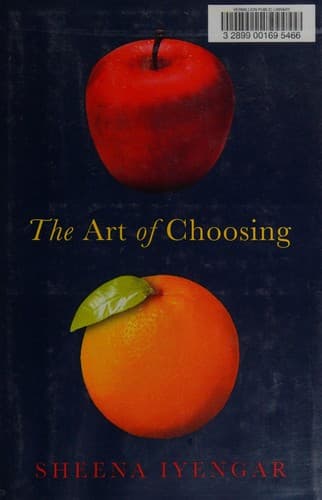
The art of choosing
A researcher's accessible tour of how culture, identity and context shape everyday decisions, with a fresh take on why having options can feel so hard.
What It's About
Sheena Iyengar, a Columbia Business School professor who has spent decades studying decision-making, takes on a question most of us answer daily without thinking: why do we choose what we choose, and what does it say about us? The book draws on her research in consumer behavior, schools and cultural comparisons, along with personal stories, and it is written for general readers rather than specialists.
Its central move is to treat choice as a learned skill and a cultural practice, not just a rational calculation. Iyengar argues that people in different societies learn to choose in different ways, that choices often express identity and relationships, and that the feeling of control matters as much as the outcome. The examples range from store shelves and tasting booths to children's decisions and the way families and communities choose together.
Reading it feels like sitting in on a long, friendly conversation with a researcher who keeps testing her own assumptions. The tone is curious rather than prescriptive, and the material moves between experiments and stories without much technical apparatus. Expect a book that asks you to notice your own choosing habits more than one that hands you a rulebook.
Read this if you…
- want a research-backed look at why you choose the way you do
- are curious about how culture shapes ordinary decisions
- often feel overwhelmed by options and want to understand why
Skip it if you…
- want a practical, step-by-step guide to making better decisions
- prefer dense academic writing with full statistical detail
Key Ideas
- 1
Choice is shaped by culture
Iyengar contrasts cultures that frame choosing as an individual right with those where choices are made in consultation with family or group. Seeing these patterns helps explain why the same menu of options can feel empowering to one person and burdensome, or even inappropriate, to another.
- 2
Too many options can paralyze
The best-known finding from her jam experiments is that large assortments sometimes reduce purchases. The book is more nuanced than popular retellings, looking at when abundance helps, when it overwhelms, and how the way options are presented changes the result.
- 3
Choices signal identity and belonging
Many decisions are less about the object than about what the choice communicates to others and to ourselves. Iyengar shows how preferences become a way of expressing who we are and where we fit, which makes everyday shopping and selecting feel more meaningful.
- 4
Agency depends on how choices are framed
Feeling in control is not the same as having more options. The book explores how defaults, presentation and the sense of being able to shape an outcome affect satisfaction, and why people sometimes prefer a smaller, better-understood set of choices.
Limitations
Some readers find the anecdotes loose and the cross-cultural generalizations broad, since national patterns can hide wide variation within any society. Much of the experimental work has been revisited since publication, and the choice overload effect in particular has faced replication debates. The book is more diagnostic than prescriptive, so it explains patterns better than it offers tools. Because it appeared in 2010, its consumer examples predate today's digital, algorithm-driven choice environments.
Questions Readers Ask
- Is The Art of Choosing still relevant today?
- Yes, mainly for its framework. The core questions about culture, identity and control still hold up. Some consumer examples feel dated given how much choice now happens through apps and recommendation systems, so treat the specific case studies as illustrations rather than current evidence.
- How does it compare to Thinking, Fast and Slow?
- Kahneman focuses on the mental shortcuts and biases inside individual minds. Iyengar focuses more on the social and cultural side of choosing, including identity, relationships and the meaning of control. Readers who enjoy one often find the other a useful complement.
- Published
- 2010
- ISBN
- 9780446504102
- Difficulty
- beginner
- Category
- Psychology
Book details and cover from Google Books.
Ready to read The art of choosing?
Get your copy on Amazon, or listen to it on Audible. We earn a commission if you buy through these links.