
We earn a commission if you buy through these links. Learn more
The Ancestor's Tale
Guide by the Books of the Day editors · Updated · How we write our guides
A pilgrimage back through time, with humans joining other species at each rendezvous, makes deep evolutionary history vivid and surprisingly personal.
What Creators Say About The Ancestor's Tale
2 creators reviewed The Ancestor's Tale on YouTube between 2021 and 2024, with 1.2K views between them. Their opinions are their own; we picked these reviews, we didn't write them.
What It's About
The Ancestor's Tale is a reverse pilgrimage. Dawkins imagines a group of travelers, each representing a living species, converging on rendezvous points as they move backward through time toward the common origin of all life. Each stop is a tale that follows the trail of shared ancestry from a more recent meeting point to an older one. The frame borrows from Chaucer, and the warmth of that device carries the book through what could otherwise be a dense sequence of biology.
The writing is lively and conversational, with Dawkins' characteristic enthusiasm and a readiness to pause for digressions. He explains how biologists read the genome and the fossil record together, how mutations accumulate, and how scientists estimate when two lineages split. Much of the pleasure comes from the way he makes distant relatives feel familiar: a human reader gets to see their own body plan, and their own genes, as one branch of a very old, still-branching family tree.
The book is best read as a sustained argument for common descent rather than a survey of every organism. Dawkins is selective, and he is openly partisan in defending evolution against its critics. Expect a long, patient read rather than a quick overview: the payoff is a feel for how deep the connections run, and for how much of your biology you share with bacteria and sea squirts.
Read this if you…
- want a readable tour of human evolution placed inside the larger history of life
- enjoy a thoughtful, opinionated science writer who explains his reasoning step by step
- already know the basics of evolution and want a deeper, more connected picture of how species relate
Skip it if you…
- want a narrow account of human fossils or prehistory alone
- need the latest genetic and paleontological findings, since the science has moved on
Key Ideas
- 1
Every living thing shares a single deep ancestry
Dawkins' central move is to treat all life as one family tree, with every species sitting at the tip of a lineage that runs back through countless shared ancestors. The reader is asked to see humans not as the peak of a ladder but as one twig among many, sharing common ancestors with chimpanzees, fish, and even bacteria at increasingly distant points.
- 2
Genomes as a record of shared descent
Dawkins uses DNA similarities and differences as a kind of archive, showing how comparing sequences between species lets biologists reconstruct when lineages diverged. He explains the logic of molecular clocks in plain terms, including why the rate of change is not perfectly steady and why estimates carry uncertainty. The argument is that genetic evidence and fossils, read together, are far stronger than either alone.
- 3
The past is a shared inheritance
Every common ancestor was a real organism with a body, a habitat, and a way of making a living. By walking the reader back to these meeting points, Dawkins makes the idea of shared ancestry concrete rather than abstract, so that living creatures appear as cousins in a single extended family rather than separate categories.
- 4
Small changes accumulate across enormous spans
Dawkins defends the idea that small heritable differences, repeated across vast stretches of time, can produce large differences in form and behavior. He addresses common misunderstandings about what evolution does and does not claim, which helps readers see why gradual change can explain the enormous variety of life without any sudden leaps.
Limitations
The book is now more than twenty years old, and genomic research has added enormous detail, including ancient DNA work on archaic humans that came after it was written. Some dating estimates and specific fossil interpretations have since been revised. Dawkins' tone, which is confident and sometimes combative toward creationism and religious readers, can read as polemical to some. The book also covers only a selection of lineages, so it is not a comprehensive catalogue of life.
Questions Readers Ask
- Is The Ancestor's Tale still worth reading today?
- Yes, for the big picture. The logic of common descent and shared ancestry has not changed. For specifics such as dating, fossil identifications, and human genetic history, newer books and papers are more reliable, so treat those parts as a starting point rather than the final word.
- How does it compare to The Greatest Show on Earth?
- The Greatest Show on Earth, which Dawkins published later, is a focused case for evolution aimed at dismantling objections. The Ancestor's Tale is more of a guided tour through the tree of life, with less emphasis on rebuttal and more on living animals and their connections. Pick the first for argument, this one for a journey.
- Published
- 2004
- ISBN
- 9781494561321
- Difficulty
- intermediate
- Category
- Science
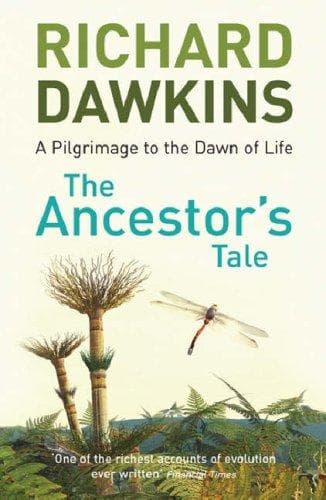
Book details and cover from Google Books.
Ready to read The Ancestor's Tale?
Get your copy on Amazon, or listen to it on Audible. We earn a commission if you buy through these links.