
We earn a commission if you buy through these links. Learn more
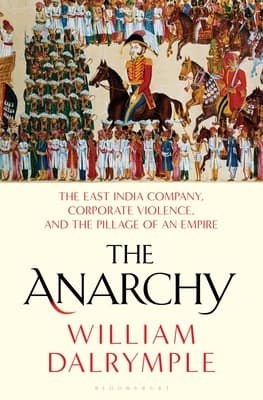
The Anarchy
Dalrymple's gripping account of how a trading company became the ruler of much of India, told through Persian sources and vivid, morally tangled characters.
What It's About
The Anarchy is William Dalrymple's account of how the East India Company, a trading firm chartered in London in 1600, went from buying spices and cloth to becoming one of the most powerful forces on the Indian subcontinent in roughly half a century. The book centres on the mid to late eighteenth century, when the Mughal Empire was weakening and regional courts in Bengal and elsewhere were competing for power. The Battle of Plassey in 1757 is the hinge, but the story keeps going through the Company's slide into corruption, its scramble for revenue, and the era of Warren Hastings.
Dalrymple works as a narrative historian who leans heavily on Persian-language chronicles, letters and court records, many written by Indian observers, rather than relying only on British archives. That gives the book a different angle from older accounts that treated the Company's rise as a lineal march of progress. The character sketches are vivid, the prose is brisk, and the intrigue, bribery and battles often read more like a thriller than a textbook.
The result is an unsettling read. You finish with a clear sense of how a corporation ended up governing millions without anyone in Britain quite deciding that it should. It is a story about money, violence and improvisation as much as about empire, and it raises uncomfortable questions about how that history is still remembered.
Read this if you…
- Want a narrative history of how the East India Company took power in India
- Already know the basics of British India and want more depth on the 1750s to 1790s
- Prefer a page-turning story with strong characters over a dense academic survey
Skip it if you…
- Want a comprehensive history of the Mughal period or of colonial rule after 1857
- Prefer a strictly analytical or economic account built on extensive statistics
Key Ideas
- 1
A trading firm that became a state
The core argument is that the Company did not set out to rule India. It began as a commercial enterprise with shareholders and profits to make, and it slid into territorial control through a series of military gambles, tax arrangements and personal ambitions. The book shows how each decision seemed reasonable at the time, and how the cumulative result was a government nobody had designed.
- 2
Plassey as a turning point, not a single battle
Plassey is usually presented as the moment British power in India began. Dalrymple treats it as one event in a messy struggle among Bengali, Mughal and European interests. Alliances shifted, rulers were bought and betrayed, and the outcome depended as much on backroom deals as on the fighting itself.
- 3
Indian voices in a British story
Because the author draws on Persian chronicles and other sources written by Indians, the events are seen from the courts and cities being fought over. Rulers, officials and merchants appear as active players with their own motives, not as passive backdrops to a British success story.
- 4
Greed, corruption and the men on the ground
A large share of the drama comes from Company servants who returned from India with enormous fortunes and sometimes with serious reputations for abuse. The book follows how private gain, weak oversight and distant decision-making fed one another, and how that culture shaped the Company's conduct in the field.
Limitations
Some reviewers feel the book leans toward a dramatic, morally pointed narrative and compresses complicated political struggles into a clear arc of rise and decline. Its focus is on courts, officials and Company men, so the lives of ordinary people during the famines and upheavals of the period get less space than the intrigue at the top. It covers a limited span of time, so readers looking for the full sweep of British rule will need other books. Specialists may also want more engagement with historiographical debates than the trade-book style allows.
Questions Readers Ask
- Is The Anarchy a good first book on the East India Company?
- It can be, as long as you are comfortable with a lot of names and shifting alliances. The narrative is engaging and the story is self-contained, but it assumes some familiarity with eighteenth-century India. Readers new to the subject may find a short overview of the Mughal decline helpful before starting, though the book itself gives enough context to follow along.
- How does The Anarchy compare to Dalrymple's earlier White Mughals?
- White Mughals, published in 2002, focuses on a different period and on personal and cultural relations between British officials and Indian elites at the Hyderabad court. The Anarchy is broader in its political scope and centres on the Company's expansion and governance. Readers who enjoyed the storytelling in one will likely find the other rewarding, though they are quite different in subject.
- Published
- 2019
- ISBN
- 9781526618504
- Difficulty
- intermediate
- Category
- History
Book details and cover from Google Books.
Ready to read The Anarchy?
Get your copy on Amazon, or listen to it on Audible. We earn a commission if you buy through these links.