
We earn a commission if you buy through these links. Learn more
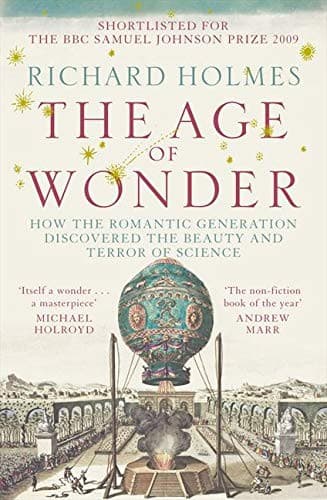
The age of wonder
Guide by the Books of the Day editors · Updated · How we write our guides
A lively narrative of Romantic-era science, following Herschel, Davy and their peers through telescopes, balloons and lab experiments. Is it for you?
What Creators Say About The age of wonder
2 creators reviewed The age of wonder on YouTube between 2010 and 2023, with 4.2K views between them. Their opinions are their own; we picked these reviews, we didn't write them.
What It's About
The Age of Wonder is a history of science written with the tools of a biographer. Richard Holmes, best known for his literary lives of Coleridge and Shelley, focuses on the generation of British scientists and explorers working roughly between the 1770s and the 1830s. Rather than surveying discoveries in order, he follows particular people through their experiments, expeditions and quarrels, so the reader comes to know William and Caroline Herschel at their telescopes, Humphry Davy in his Bristol laboratory, and the balloonists who went up for the sheer thrill of it.
The approach is more storytelling than textbook. Holmes moves between laboratory detail and personal letters, and he is interested in how these men and women felt about what they were doing: the excitement of a new finding, the fear of a dangerous experiment, the sense that the natural world was suddenly larger than anyone had imagined. Literary figures such as Coleridge appear as witnesses and friends, which helps tie science to the wider culture of the period.
Reading it is a pleasant, immersive experience. Chapters feel like connected episodes rather than a single argument, and the pace is brisk. You finish with a clearer sense of how scientific work looked from the inside in that period, and of why its practitioners often described their own pursuits in the language of poetry.
Read this if you…
- are curious about how science was actually practised two centuries ago
- enjoy biography and character-driven narrative history
- like the idea that poetry and experimentation once belonged together
Skip it if you…
- want a clear, technical account of specific scientific theories
- are looking for a comprehensive survey of all major discoveries of the period
Key Ideas
- 1
Science as an emotional and imaginative pursuit
Holmes argues that the scientists of this era were driven by wonder as much as by method. Their notebooks and letters show curiosity, awe and even terror at what they uncovered. Seeing science as a feeling-filled human activity, rather than a detached procedure, is the book's central lens, and it makes the discoveries feel personal and immediate.
- 2
Exploration and experiment as shared adventure
Whether in the Arctic, over the English countryside in a balloon, or inhaling gases in a laboratory, the period's researchers took real physical risks. Holmes shows how danger and discovery were tightly bound together, and how that willingness to take chances shaped the reputation and self-image of the men and women involved.
- 3
The Romantic link between poetry and science
The book shows poets and scientists trading ideas, attending the same lectures and sharing a belief that imagination could reach truths about nature. Holmes suggests these fields were not yet sharply separated, and that the best scientists of the time were often also writers, observers and public performers.
- 4
Communicating discovery to a curious public
Lectures, demonstrations and popular accounts made science a public spectacle in this period. Holmes examines how audiences were drawn in, and how the excitement of showing discoveries to others helped shape what scientific work meant to ordinary people and to the researchers themselves.
Limitations
The book is selective by design. It concentrates on a handful of figures and episodes, mostly British, so readers wanting a wider European or global picture will need other sources. Its emphasis on personality and anecdote means some scientific developments are sketched rather than explained in depth. Some readers may also find the enthusiasm for heroic individuals a little romanticised, though Holmes is generally careful with his sources.
Questions Readers Ask
- Do I need a science background to enjoy The Age of Wonder?
- No. The book is written for general readers and explains experiments and discoveries in plain language. Some familiarity with basic chemistry or astronomy will help, but the emphasis is on people and their experiences rather than on technical detail, so most curious adults will follow it easily.
- How does it compare with a standard history of science?
- A standard history of science usually aims for breadth and a clear sequence of ideas. This book goes the other way: it chooses a few vivid characters and lingers on their lives and emotions. If you want the full map of the period, pair it with a more systematic survey.
- Published
- 2008
- ISBN
- 9780007149520
- Difficulty
- intermediate
- Category
- Science
Book details and cover from Google Books.
Ready to read The age of wonder?
Get your copy on Amazon, or listen to it on Audible. We earn a commission if you buy through these links.